
Decoding the technologies of tomorrow, today.
Exploring the breakthrough innovations shaping our world. From AI infrastructure and robotics to biotech, quantum computing, and spatial tech.
Exploring the breakthrough innovations shaping our world. From AI infrastructure and robotics to biotech, quantum computing, and spatial tech.
Industrial robotic arms have transformed manufacturing by performing highly repeatable tasks in environments designed around the machine. A typical fixed-base manipulator may have six or more degrees of freedom, allowing it to position and orient a tool throughout a defined workspace with considerable precision. Its joints still have to overcome gravity, inertia, friction, and actuator limitations, but the robot's base remains anchored to a rigid structure. That single constraint removes an enormous amount of complexity from the control problem. Engineers know where the robot is relative to the floor, can characterize its workspace in advance, and can design fixtures and production processes around predictable contact conditions.
A bipedal humanoid has to operate under a very different set of physical constraints. Its base is effectively floating, while its feet provide intermittent and unilateral contact with the environment. The robot must continuously coordinate its joints, body momentum, ground reaction forces, and contact conditions while responding to surfaces and objects that may not behave exactly as expected. The challenge is therefore not simply that a humanoid contains more motors or joints. The deeper difficulty comes from having to control the entire body while maintaining useful interaction with an environment that cannot always be treated as fixed. Understanding that distinction explains why a humanoid can be dramatically more difficult to engineer than a conventional fixed-base manipulator.
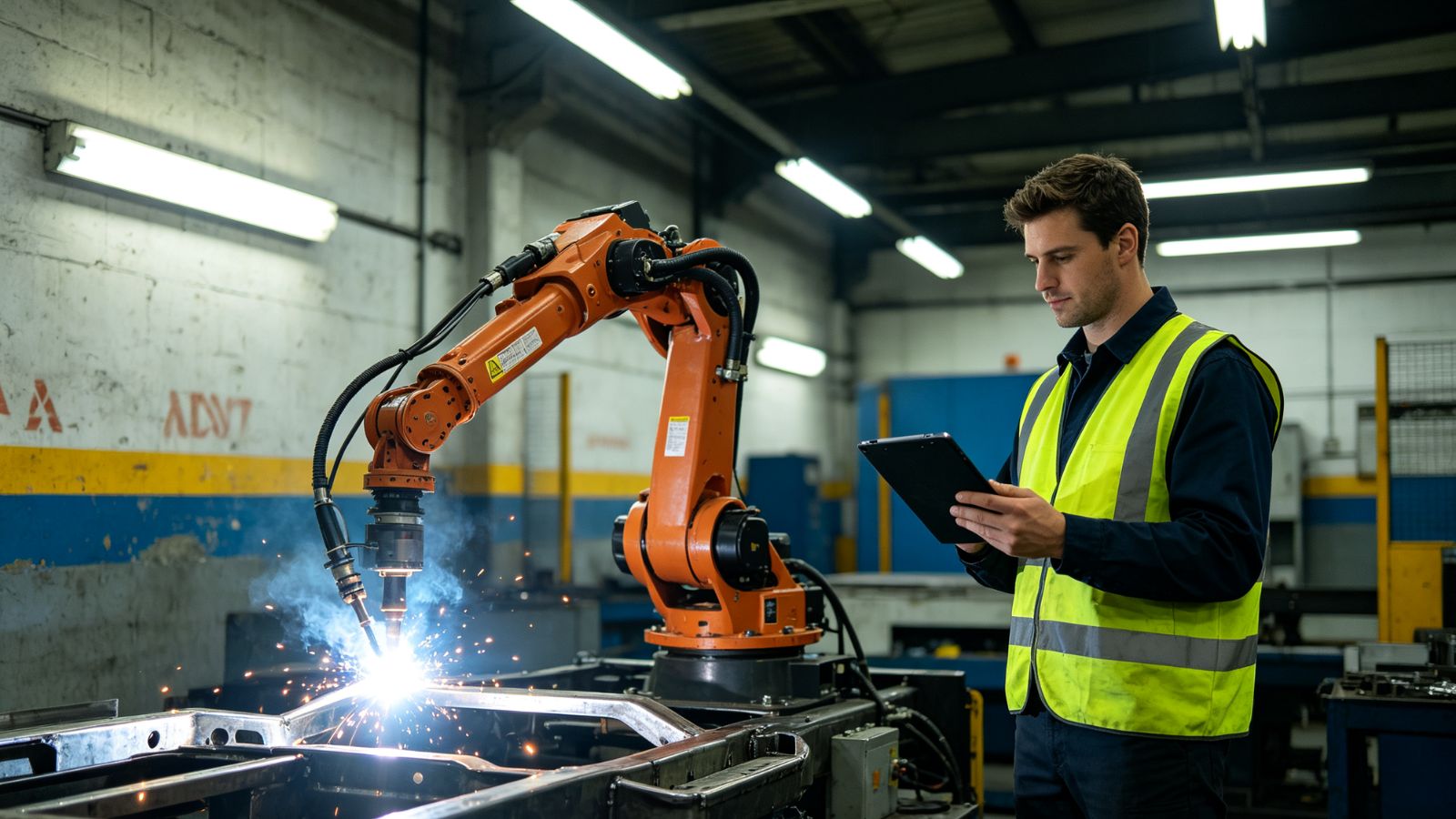
A conventional industrial arm benefits enormously from having its base bolted to the floor. Its position and orientation relative to the working environment are known, and forces generated by the joints ultimately react through a structure that does not need to maintain balance. Engineers can use established tools such as forward and inverse kinematics, Jacobians, screw theory, and rigid-body dynamics to predict how joint motion will affect the end effector. Gravity compensation, inertia, Coriolis effects, and friction still require careful modeling, but the robot operates inside a comparatively stable mechanical framework. If the arm accelerates a payload, the resulting reaction forces are ultimately absorbed by the mounting structure rather than changing the location of the robot itself.
A humanoid does not have that luxury. Its floating base means that motion of one body segment can influence the motion of the entire system, while the feet provide constraints that depend on whether they are planted, lifting, sliding, or making contact again. The robot cannot simply assume that an external structure will absorb every reaction force. Instead, it has to manage its body momentum and the forces exchanged with the ground at the same time that it performs a task. Balance can be analyzed using several related frameworks, including the support polygon, zero-moment point, capture-point methods, and divergent-component-of-motion approaches. These frameworks describe different aspects of stability, but they all reflect the same underlying problem: the robot has limited opportunities to correct an unstable state once its momentum and contact conditions move beyond what its actuators and environment can support.
This changes the nature of control. A humanoid reaching for an object may need to coordinate its arm, torso, hips, knees, ankles, and feet because the reaching motion changes the distribution of mass and the forces required at the ground. A controller must therefore satisfy several constraints simultaneously, including joint limits, actuator capabilities, contact friction, balance requirements, and the task itself. Low-level actuator and state-estimation loops may operate at hundreds of hertz, while higher-level planning and perception generally run at different rates. The important point is not that every humanoid controller operates at one particular frequency, but that several control loops must cooperate quickly enough to prevent small disturbances from becoming large body-level errors.
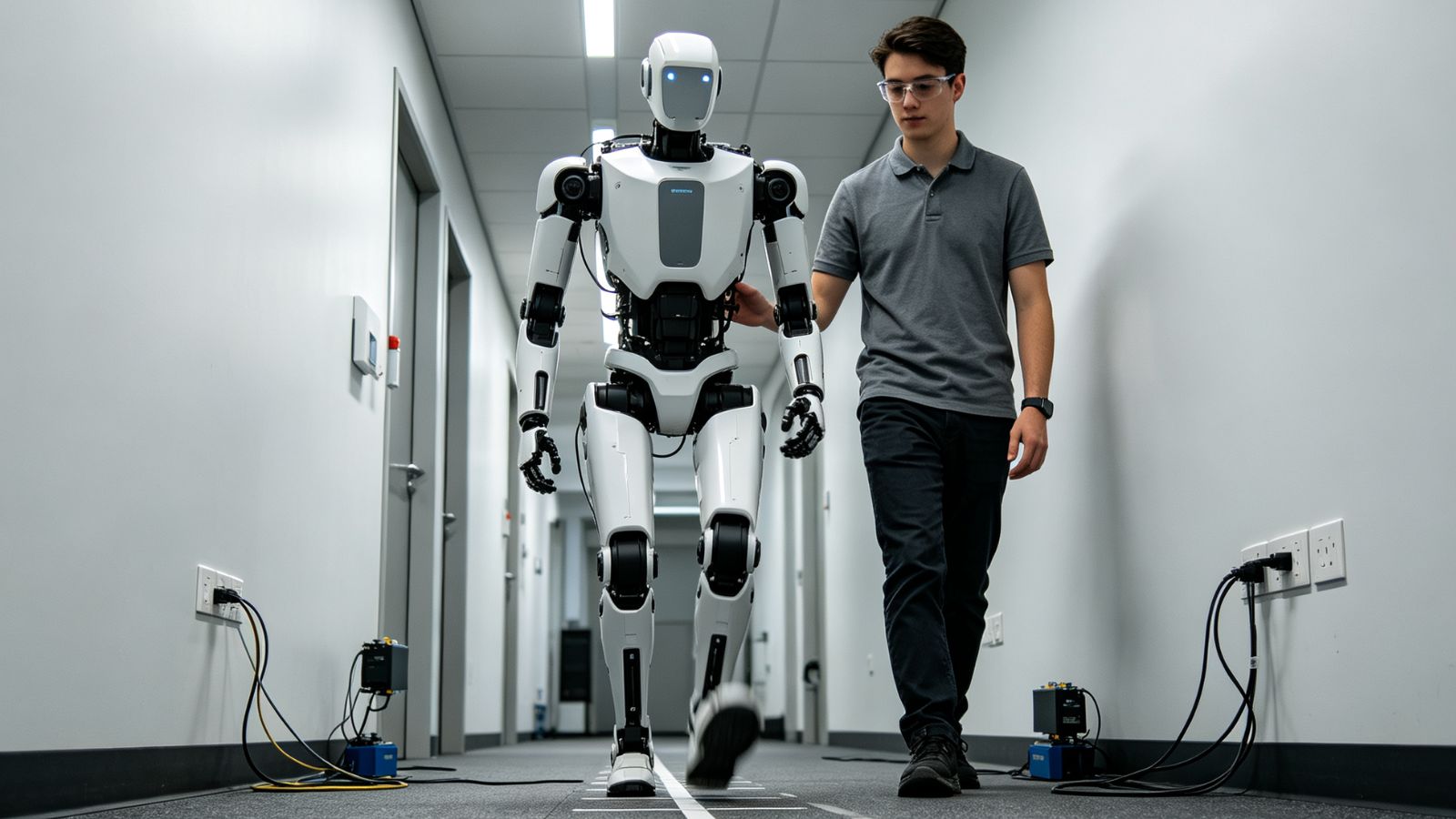
Humanoid platforms can span a wide range of degrees of freedom, from relatively simple research machines to highly articulated systems containing dozens of independently controlled joints. More joints provide additional ways to position the body, manipulate objects, and adapt to obstacles, but the raw number of degrees of freedom is not what makes humanoid control fundamentally difficult. The harder problem is that those degrees of freedom are mechanically and dynamically coupled through a floating body. A change in one joint can alter the center of mass, angular momentum, ground reaction forces, or the forces required at another contact point. The controller therefore cannot treat the legs, torso, and arms as completely independent subsystems in the way a conventional fixed-base manipulator often can.
This coupling becomes particularly important when the robot interacts with its environment. Consider a humanoid pushing a cart. An industrial arm can perform a similar action while its base transfers the reaction force into the floor through a rigid mounting structure. A humanoid has to generate an equivalent force while preventing that force from producing an unwanted body acceleration or foot slip. The robot may need to lean into the interaction, adjust its foot placement, redistribute joint torques, and monitor whether the available friction can support the resulting forces. The same principle applies when carrying an object, opening a heavy door, pulling a handle, or catching itself after a disturbance. What appears to be an arm movement can become a whole-body control problem because the environment pushes back on the robot.
Actuator selection adds another layer of complexity. Industrial arms can often use relatively high gear reductions because their applications tolerate limited backdrivability and predictable joint trajectories. Humanoid legs operate under repeated impacts and rapidly changing loads, making compliance, torque density, mechanical efficiency, and shock tolerance much more important. Series-elastic and quasi-direct-drive actuators can improve force control or reduce reflected inertia, but they also introduce additional mechanical behavior that the controller must understand. The result is a design tradeoff between strength, speed, compliance, efficiency, durability, and controllability. Increasing performance in one dimension can create a new constraint somewhere else, which is why humanoid actuator design cannot be separated cleanly from the robot's overall control architecture.
The most important difference between a fixed-base manipulator and a walking humanoid may not be the number of joints at all. It is the fact that the humanoid repeatedly changes how it is connected to the environment. A robot standing on two feet has one set of physical constraints; lifting one foot produces another; landing that foot creates a new contact state. If a hand touches a wall, the available reaction forces change again. These transitions are often called contact modes, and each mode changes the constraints that the robot must satisfy. A humanoid controller therefore has to reason not only about where the joints should move, but also about which parts of the body are currently interacting with the environment and whether those contacts can support the intended motion.
This becomes especially difficult because real contact is rarely ideal. The robot may estimate that a foot is planted firmly, only to encounter a surface with less friction than expected. A hand may touch an object slightly earlier than planned, or an object may move instead of remaining rigid. Even the geometry of a supposedly familiar environment can contain small uncertainties that matter during dynamic motion. These situations make humanoid control different from simply solving a larger inverse-kinematics problem. The feasible set of motions can change when a contact appears, disappears, slips, or fails to provide the expected force. A successful system therefore needs state estimation, contact detection, force control, and motion planning to work together rather than treating physical interaction as a secondary detail.
Walking illustrates the consequence particularly well. A biped does not remain statically balanced throughout a normal step; it deliberately shifts its body and momentum so that the next foot can provide support. Small disturbances can often be handled through ankle or hip adjustments, while larger disturbances may require a change in foot placement. If the available recovery options are exhausted, the robot may have to enter a controlled fall or another safe state. Humans perform these corrections through tightly integrated sensory and motor systems, but a robot has to approximate them using inertial measurements, joint encoders, force and torque sensing, and other sources of information. The difficulty lies not in any single sensor or algorithm, but in combining imperfect information with rapidly changing contact conditions.
Bipedal locomotion is therefore a continuous exercise in managing momentum under uncertainty. A humanoid has to estimate its body state while simultaneously predicting how its current motion will interact with the ground. Sensors inevitably contain noise, while physical models contain approximations. Foot compliance, actuator elasticity, friction, structural flex, and small differences in mass distribution can all affect the result. In a controlled factory cell, engineers can reduce many of these uncertainties through fixtures, standardized surfaces, and carefully defined robot trajectories. A humanoid intended to work in ordinary human environments cannot make the same assumptions. Floors can change from concrete to carpet, ramps can introduce different geometry, and objects or people can move unexpectedly.
This uncertainty also changes how recovery should be designed. A fixed-base arm may detect an unexpected collision and stop or adjust its trajectory while remaining physically supported by its base. A humanoid has to determine whether the disturbance affects only the current task or threatens the stability of the entire body. A small external force might be absorbed through ankle motion, while a larger disturbance could require coordinated hip movement or an immediate change in foot placement. The controller must make these decisions while the robot is already moving. That creates a much tighter relationship between perception, state estimation, planning, and actuation than is normally required for a manipulator operating in a highly structured workspace.
Energy management adds another constraint. A fixed industrial arm can draw power continuously from an external electrical system, and its thermal design can be built around a known duty cycle and stationary infrastructure. A humanoid intended to move freely has to carry its own batteries, motors, power electronics, and cooling hardware. Every unnecessary movement consumes energy, while high-torque operation can generate heat inside components that have limited physical volume for cooling. Designers therefore have to balance payload, walking speed, actuator strength, battery capacity, thermal limits, and operating time. Improving one of these characteristics can reduce another, making energy efficiency part of the mechanical and control problem rather than simply an electrical engineering consideration.
Simulation is indispensable for humanoid development because testing every possible behavior directly on hardware would be expensive, slow, and potentially unsafe. Physics engines allow engineers to explore locomotion strategies, actuator requirements, body configurations, and recovery behaviors before committing them to physical machines. They can also run thousands of trials to identify patterns that would be difficult to observe experimentally. For conventional industrial robots operating in carefully controlled environments, the transition from simulation to hardware can often be made comparatively predictable because the workspace, contact surfaces, and task sequence are tightly constrained.
Humanoid robotics faces a wider reality gap because physical interaction is central to the task. A simulation may approximate friction, but the real surface can behave differently. A model may represent an actuator as having a particular compliance, while the physical mechanism has temperature-dependent behavior or small mechanical tolerances. A foot may appear to make perfect contact in simulation while the physical robot experiences a subtle impact or deformation. These discrepancies do not necessarily make simulation unreliable; they demonstrate why simulation has to be combined with hardware testing, system identification, sensor feedback, and robust control. The more a task depends on uncertain contact dynamics, the more important it becomes to design controllers that can tolerate modeling errors rather than assuming that every physical parameter is known precisely.
Machine learning can further improve this process, particularly when it is used to discover control policies or adapt models from large numbers of simulated and physical trials. But learned behavior does not remove the underlying mechanical constraints. A policy still has to operate within actuator limits, friction conditions, sensor uncertainty, and the physical geometry of the robot. This is one reason successful humanoid systems increasingly depend on combinations of model-based control, optimization, learned components, and carefully designed hardware. The challenge is not to find one algorithm that solves walking, manipulation, and balance independently. It is to build a system in which multiple approaches remain useful when the environment behaves differently from the assumptions made during development.
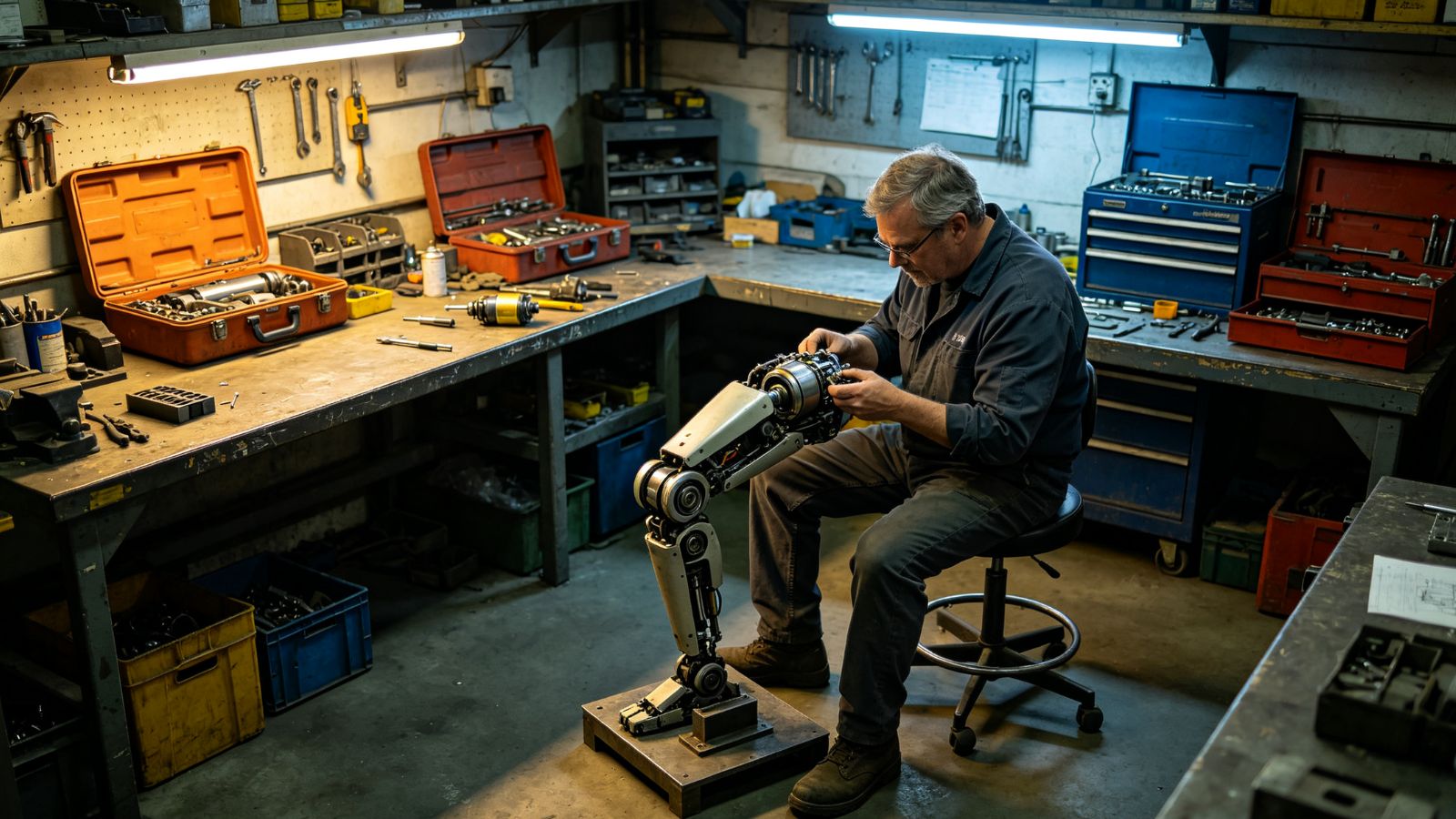
The complexity of a humanoid also changes the meaning of reliability. A conventional industrial arm can still have many potential failure points, but its operating environment is usually designed to reduce uncertainty. Its trajectory, payload, tooling, mounting structure, and surrounding equipment can be specified in advance. Maintenance schedules can be built around known operating cycles, and unexpected interactions can often be handled through established safety procedures. The result is a system whose reliability depends heavily on mature mechanical components and a controlled operating envelope.
A humanoid has a much broader set of possible failure interactions. A degraded actuator can change the robot's gait, which can alter its balance and increase the load on other actuators. A faulty sensor can produce an incorrect estimate of body orientation, potentially affecting the control decisions made by multiple joints. An unexpected collision can change the contact state and invalidate assumptions that were valid a fraction of a second earlier. These effects make fault detection and graceful degradation especially important. A capable humanoid cannot simply be optimized for normal operation; it also needs strategies for recognizing when its assumptions are no longer valid and responding without turning a local fault into a system-level failure.
That requirement influences the entire engineering stack. Mechanical designers need to consider how components fail, controls engineers need to design recovery behavior, software engineers need reliable state estimation and fault handling, and system designers need to understand how one subsystem can affect another. This is one reason adding more sensors or more advanced AI does not automatically make a humanoid robust. Reliability emerges from the interaction between hardware, software, sensing, control, power, and the environment. The broader the operating envelope, the more difficult it becomes to validate that all of those interactions remain safe and predictable.
None of this means that industrial robotic arms are simple machines. High-performance manipulators involve sophisticated mechanics, precise calibration, advanced motion planning, force control, safety systems, and demanding manufacturing requirements. The difference is that fixed-base robots can take advantage of an unusually favorable physical arrangement. Their base is stable, their workspace can be engineered around the machine, and many of their interactions can be constrained or anticipated. Those conditions allow engineers to isolate problems that would otherwise become tightly coupled.
A bipedal humanoid gives up many of those advantages in exchange for mobility and versatility. It must carry its own structure and energy source, maintain balance through changing contacts, coordinate many interconnected joints, respond to uncertain surfaces, and manipulate objects without losing stability. The resulting problem is not simply a larger version of industrial robot control. It is a different combination of mechanics, dynamics, estimation, planning, and interaction control. The most difficult part is often the boundary between the robot and the environment, because that boundary determines what forces are available and what motions remain physically feasible.
This perspective also explains why progress in humanoid robotics is likely to be incremental. Better actuators can improve torque density and efficiency, but they do not eliminate contact uncertainty. Better sensors can improve state estimation, but they do not create additional physical stability. More capable learning systems can improve adaptation, but they still operate within the limits of motors, batteries, friction, and mechanical structure. The long-term challenge is therefore one of integration: building hardware and software that can continuously coordinate these constraints while remaining reliable enough for real-world use. That is what makes a capable bipedal humanoid significantly harder to engineer than a conventional fixed-base robot arm—not simply the number of joints, but the need to make the entire machine behave as one dynamically coupled system.