
Decoding the technologies of tomorrow, today.
Exploring the breakthrough innovations shaping our world. From AI infrastructure and robotics to biotech, quantum computing, and spatial tech.
Exploring the breakthrough innovations shaping our world. From AI infrastructure and robotics to biotech, quantum computing, and spatial tech.
When artificial intelligence models process language, recognize images, or generate predictions, they execute trillions of mathematical calculations. Training a modern large language model or running real-time inference requires processing oceans of data simultaneously. If you open a standard computer's task manager during an intensive AI workload, you will notice that the machine relies almost entirely on Graphics Processing Units (GPUs) rather than the Central Processing Unit (CPU).
This hardware shift is not a marketing preference; it is a fundamental necessity dictated by computer architecture. To understand why artificial intelligence depends so heavily on parallel GPU processing, we have to examine the profound structural differences between how CPUs and GPUs execute instructions.
To grasp the distinction between CPUs and GPUs, consider an everyday analogy. Imagine you need to move a million bricks from one side of a construction site to the other.
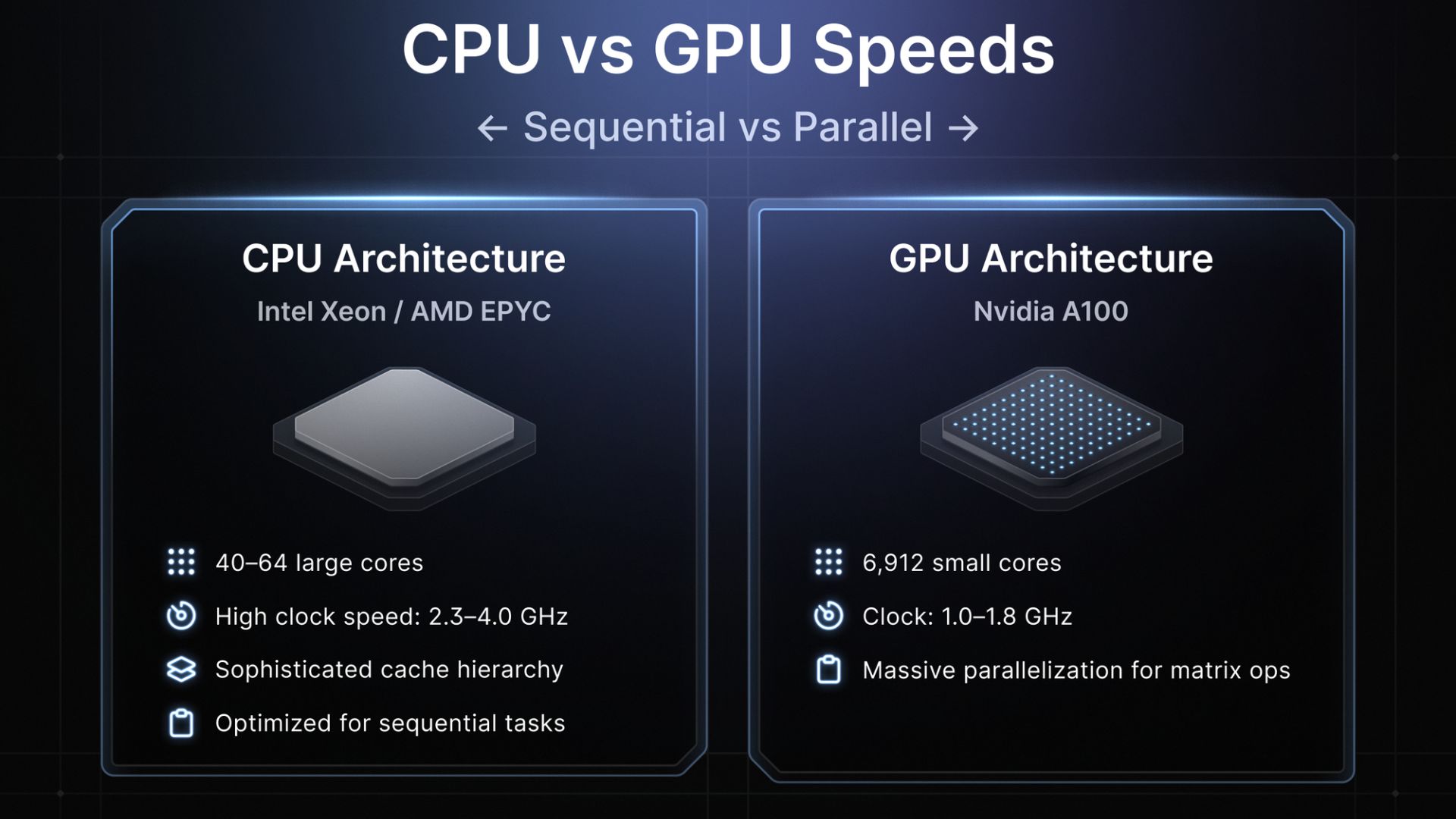
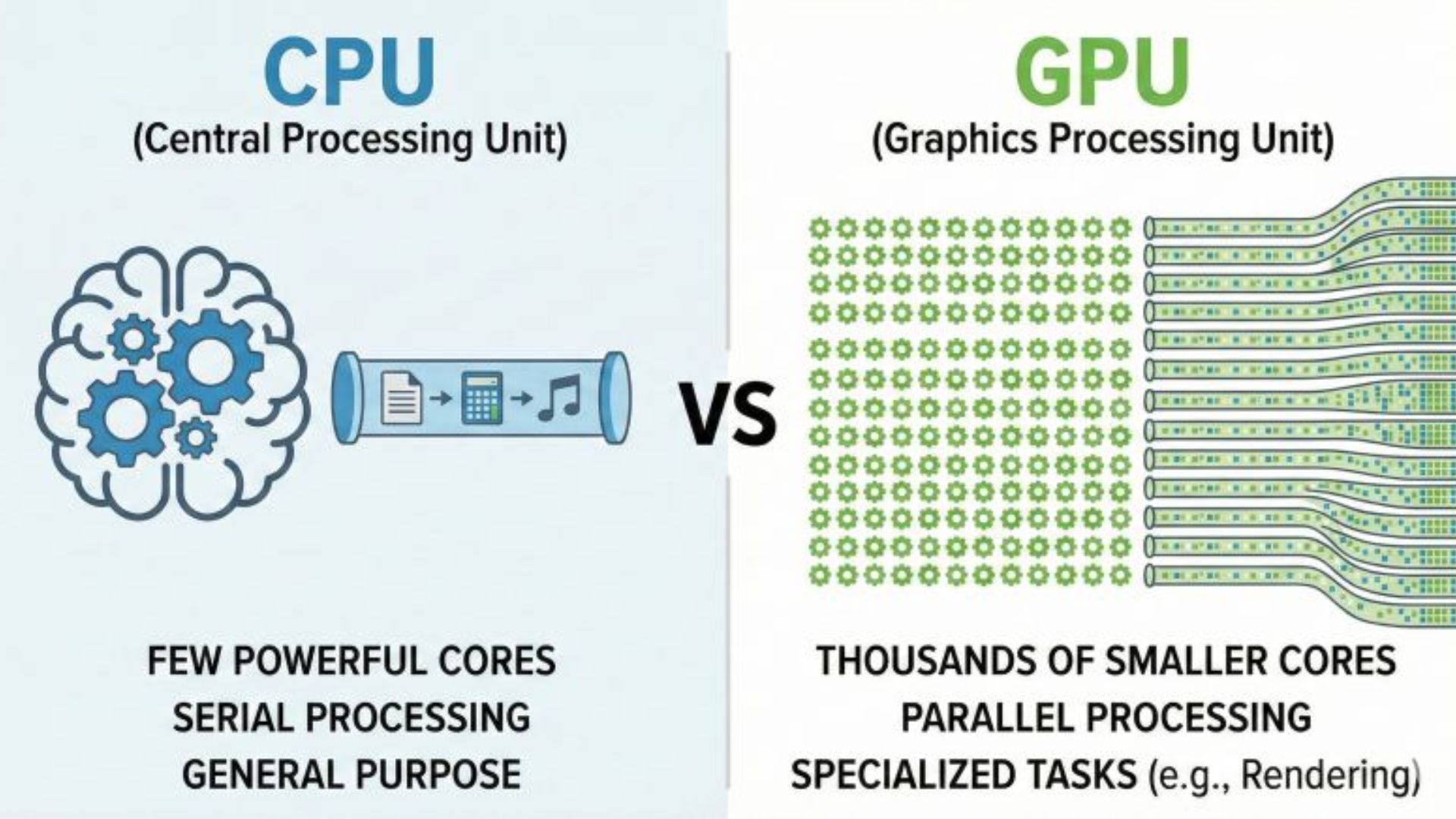
A traditional CPU is like a high-speed sports car. It features a small number of immensely powerful cores (typically 8 to 24 cores in consumer hardware) optimized to carry a single load across town at incredible speed. It handles complex, branch-heavy logic, operating systems, and sequential instructions with elite proficiency. If you need to evaluate complex logical branching or execute a single task with minimal latency, the CPU is unmatched.
A GPU, by contrast, is like a massive freight train with thousands of boxcars. Instead of having a few blindingly fast cores, a GPU contains tens of thousands of smaller, simpler cores designed to operate simultaneously. While an individual GPU core is slower and less flexible than a CPU core, the sheer volume of cores allows the chip to move millions of items at the exact same moment.
In computer science, this distinction separates latency optimization (processing a single instruction as fast as possible) from throughput optimization (processing massive quantities of independent instructions simultaneously).
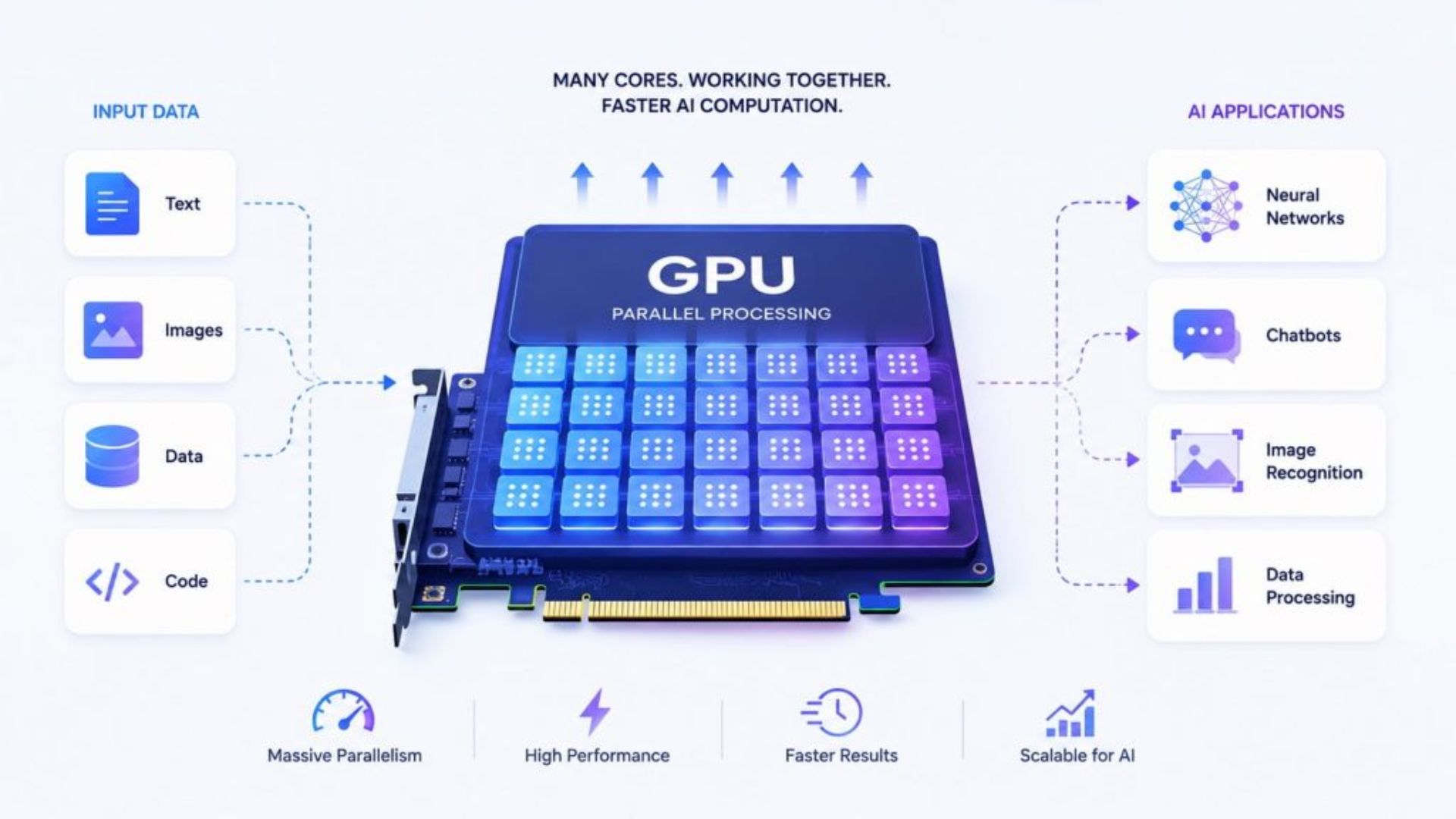
Artificial intelligence, particularly deep learning and neural networks, does not rely on complex sequential logic chains. Instead, AI computation is dominated by a single mathematical operation: matrix multiplication.
A neural network consists of layers of artificial neurons interconnected by numeric weights. Evaluating a single layer requires multiplying massive arrays of numbers—representing inputs and weights—across billions of parameters.
The crucial characteristic of matrix multiplication is that individual calculations are largely independent of one another. When multiplying row $A$ by column $B$, the math required for element $1$ does not need to wait for element $2$ to finish.
On a traditional CPU, these matrix operations must be handled sequentially or in very small batches. Even with multi-threading, a CPU would bog down trying to process millions of scalar multiplications one after another, creating a severe computational bottleneck.
A GPU tackles this exact problem by distributing the individual multiplications across thousands of parallel execution units. While the CPU calculates matrix cells one by one or in tiny groups, the GPU computes thousands of multiplications simultaneously in a single clock cycle. This architectural alignment transforms operations that would take days or weeks on a sequential CPU into tasks completed in fractions of a second.
It is a historical irony that chips originally designed to render bouncing polygons in 3D video games became the engine of the artificial intelligence revolution.
In the late 1990s and 2000s, video game developers pushed hardware manufacturers to render complex lighting, shadows, and textures in real time. This required processing millions of pixels simultaneously—a task that naturally demanded parallel processing. GPU manufacturers like NVIDIA built specialized pipelines capable of handling floating-point arithmetic across massive arrays of pixels.
Around 2012, deep learning researchers realized that the floating-point math required to shade pixels in a video game was mathematically identical to the matrix operations required to train deep neural networks. By repurposing graphics hardware for general-purpose parallel computing (a paradigm known as GPGPU), researchers unlocked unprecedented training speeds, launching the modern AI boom.
Despite their dominance, GPUs are not a universal panacea. Their massive power consumption, high manufacturing costs, and memory bandwidth constraints present ongoing engineering challenges.
Furthermore, GPUs excel primarily at dense matrix multiplication. For other computational tasks—such as symbolic reasoning, agentic decision-making trees, or complex logical parsing—CPUs still play an essential coordinating role.
This reality has driven the development of application-specific integrated circuits (ASICs) and Tensor Processing Units (TPUs), which take the parallel philosophy of GPUs even further by tailoring silicon circuits specifically for tensor operations. However, the foundational principle remains unchanged: AI computing belongs to parallel architectures.
The reliance of artificial intelligence on GPUs rather than CPUs highlights a fundamental rule of hardware design: form follows function. Because neural networks process vast oceans of independent matrix data simultaneously, they require throughput over raw serial speed.
By replacing the single-minded velocity of the traditional CPU with the massive, coordinated army of cores inside a GPU, modern computing transformed theoretical neural network models into practical, scalable intelligence.