
Decoding the technologies of tomorrow, today.
Exploring the breakthrough innovations shaping our world. From AI infrastructure and robotics to biotech, quantum computing, and spatial tech.
Exploring the breakthrough innovations shaping our world. From AI infrastructure and robotics to biotech, quantum computing, and spatial tech.
Picking up a ripe tomato without bruising it, or turning a key without losing the grip, requires more than accurate positioning. A robot has to recognize when contact begins, estimate whether the applied force is sufficient, detect early signs of slip, and change its grip before the object moves beyond recovery. Vision can provide a strong estimate of object shape and location, but contact itself happens at the interface between the robot and the object. That interface contains information about pressure, shear, friction, deformation, and vibration that a camera does not directly measure. Tactile feedback brings some of that information into the control loop, while adaptive gripping gives the robot a way to respond to it. Together, they turn manipulation from a mostly geometric problem into a continuous interaction between sensing, mechanics, and control.
The value of tactile feedback becomes clearer when objects are uncertain. A rigid metal component can often be grasped using a predictable force, but a soft package, irregular household object, or fragile piece of produce may behave differently from its visual appearance. Surface friction can vary, the center of mass may be offset, and the object can deform as the fingers close. A robust robotic hand therefore cannot depend entirely on a single precomputed grasp. It needs to establish contact, evaluate what is happening at that contact, and adjust the mechanical response as conditions change. This does not mean tactile sensing replaces vision or planning. Instead, it adds a local source of information that becomes especially valuable after physical contact, when the robot needs to know not only where an object is but how the object is responding to the forces being applied.
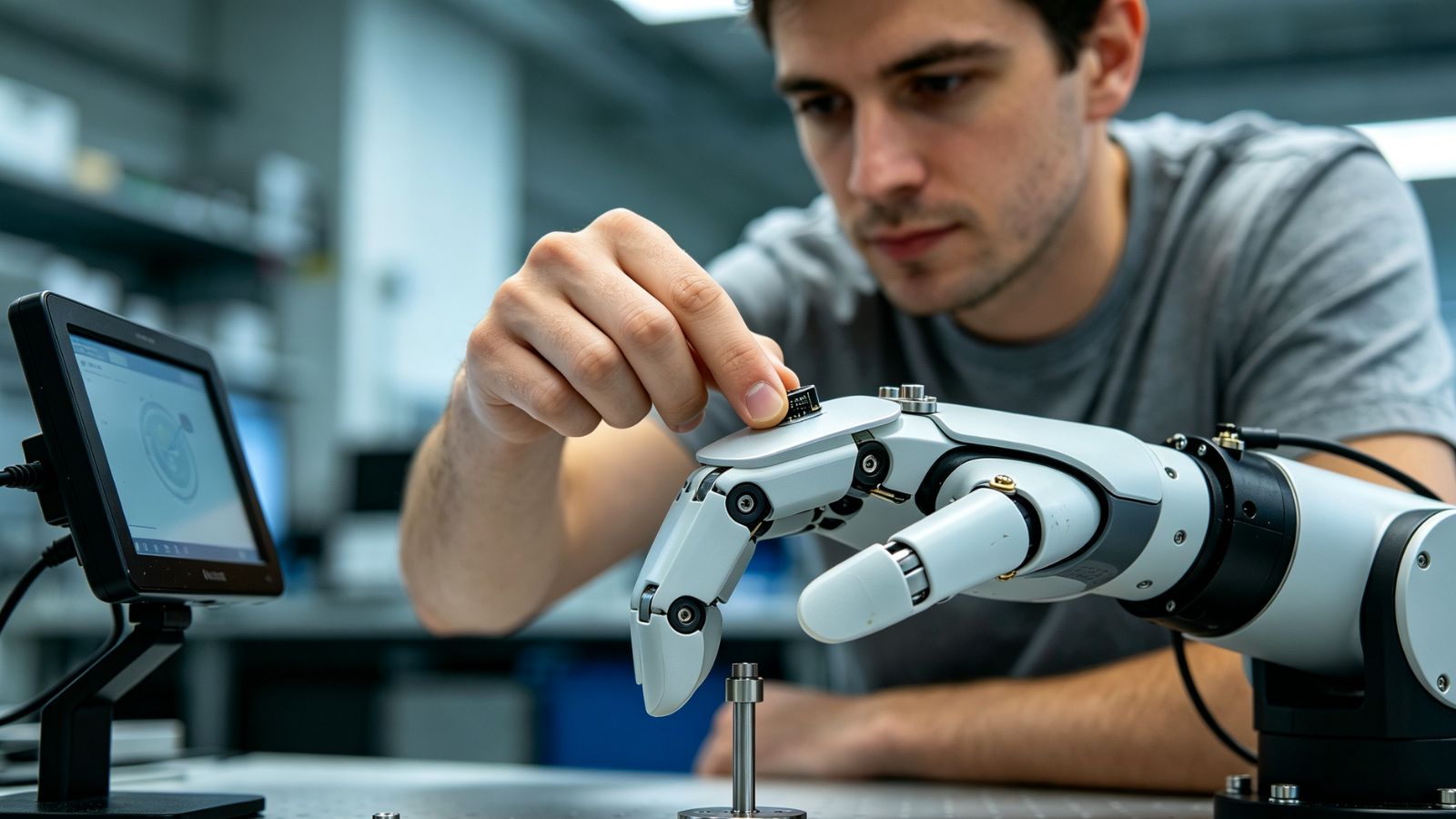
Cameras and depth sensors are excellent at estimating an object's position, geometry, orientation, and motion, but they do not directly measure the forces and pressure distributions at the contact interface. A camera may show that a robotic finger has reached the expected location, yet it cannot by itself determine whether the finger is pressing too hard, whether contact has occurred over the intended surface, or whether the object is beginning to slide against the fingertip. Those distinctions matter because grasp stability depends on physical interaction, not simply geometric alignment. A robot can have an accurate visual estimate and still produce an unstable grasp because the object's friction, stiffness, mass distribution, or exact contact location differs from the assumptions used during planning. Tactile sensing provides another layer of information by measuring what happens at the point where the robot and object actually meet. This allows the controller to respond to physical conditions that are difficult to infer reliably from vision alone.
The distinction becomes especially important once the robot starts manipulating an object rather than merely picking it up. A grasp that is stable while an object is stationary may become unstable when the wrist rotates, the object accelerates, or an external force is applied. Tactile measurements can reveal changes in local pressure, shear, deformation, or vibration that indicate the contact state is changing. The controller can then adjust finger force, joint position, or wrist motion rather than continuing to execute a fixed trajectory. In this sense, tactile feedback does not replace visual perception; it fills a different part of the information gap. Vision is particularly useful before contact and for observing the wider environment, while tactile sensing becomes especially valuable when the robot needs to understand the local mechanical consequences of its actions. Reliable manipulation emerges when those sources of information are treated as complementary rather than competing.
Robotic tactile sensors use several physical principles, and each is better suited to certain kinds of contact information. Resistive and capacitive arrays can measure distributed pressure across a fingertip or palm, making them useful when the controller needs to know where an object is contacting the hand and how force is distributed. Piezoelectric and related sensing elements are particularly useful for detecting fast changes, vibration, and transient contact events. Vision-based tactile sensors take another route: a soft transparent layer deforms when it touches an object, and an internal camera observes that deformation to estimate contact geometry and force-related features. Magnetic and optical approaches can also provide multi-axis measurements. The important distinction is not that one technology is universally better, but that each exposes a different part of the contact state. A useful sensor architecture therefore starts with the manipulation task rather than with maximum resolution alone.
Sensor selection also involves practical constraints that are easy to overlook in laboratory demonstrations. A dense tactile array can provide detailed spatial information, but hundreds or thousands of sensing elements create challenges in wiring, calibration, signal processing, and mechanical packaging. Soft sensing surfaces conform naturally to curved objects and can distribute contact loads, yet their materials may exhibit hysteresis, drift, or changes in response after repeated use. A wrist-mounted force-torque sensor offers accurate information about the overall force and moment applied to the hand, but it cannot identify the exact pressure pattern at each fingertip. For many systems, the most useful architecture is therefore multimodal: vision establishes the object and intended grasp, fingertip sensing monitors local contact, and a wrist sensor measures the net mechanical interaction. The goal is not to collect every possible signal, but to obtain enough information to make the next control decision reliably.
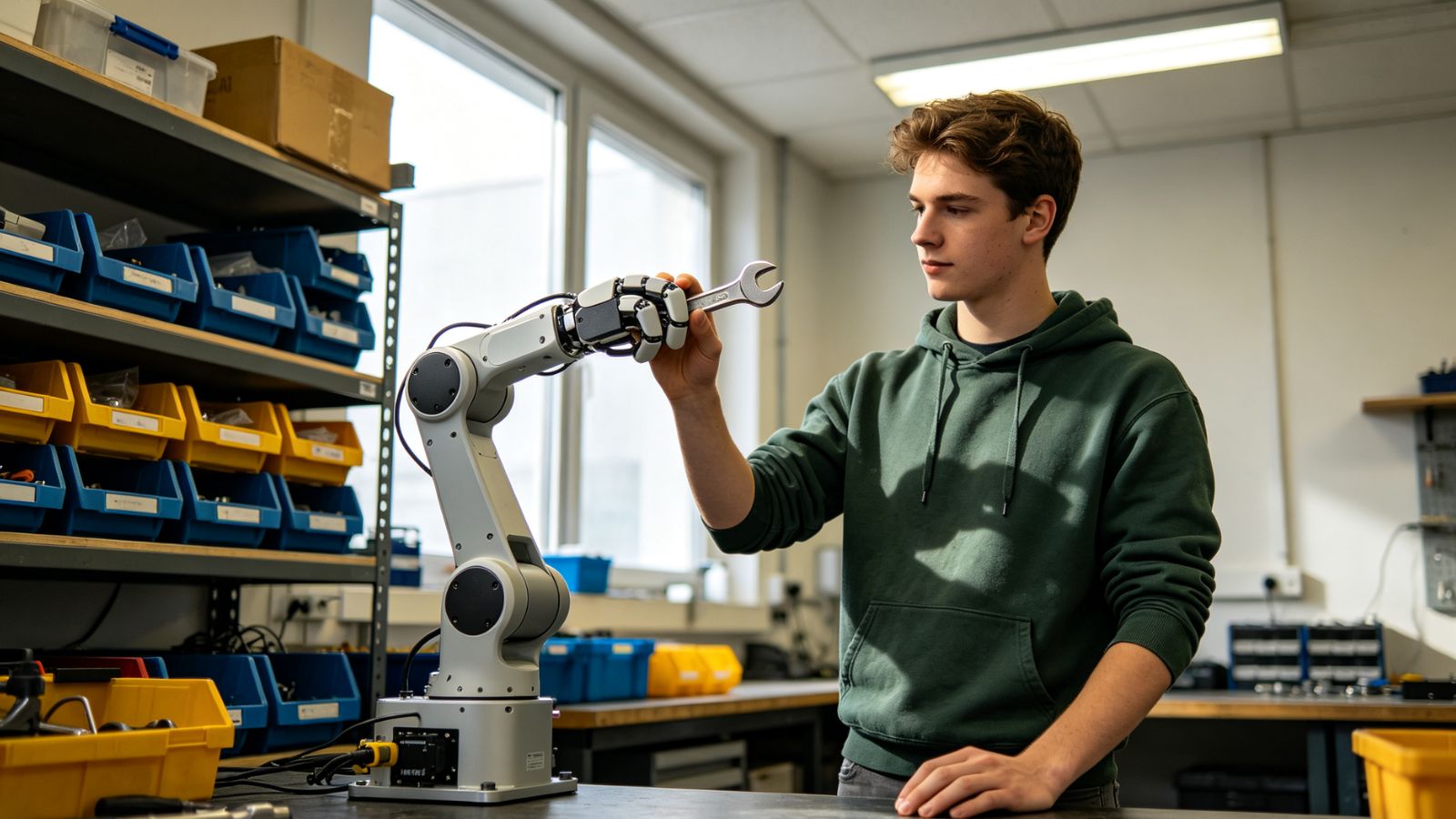
Tactile sensing works best when the mechanical structure of the hand allows contact information to influence motion rather than simply recording it. Compliant fingers can deform around small variations in object shape, increasing contact area and reducing sensitivity to exact grasp geometry. Underactuated hands take this idea further by mechanically coupling several joints, allowing the fingers to conform passively to objects without requiring an independent actuator at every joint. This can reduce hardware complexity while providing useful adaptability. Fully actuated hands offer more deliberate control over individual contact points and finger forces, but they require additional actuators, sensing channels, control bandwidth, and mechanical packaging. The sensor layer itself must also survive the same contacts it is designed to measure. Protective skins, elastomers, wiring, and embedded electronics all have to tolerate repeated loading, friction, contamination, and occasional impacts. In practical manipulation, sensing and mechanical design cannot be treated as separate subsystems.
The choice between compliance and precise actuation depends heavily on what the robot is expected to manipulate. A gripper moving standardized metal parts on an assembly line may benefit more from repeatability, durability, and simple force control than from a high-resolution tactile skin. A household robot facing cups, clothing, packaging, tools, and irregular objects has a different problem because the contact geometry may change from one attempt to the next. Passive compliance can absorb some of that uncertainty before the controller has to react, while tactile feedback can identify whether the resulting contact is stable. There is a similar trade-off between sensor coverage and robustness. Covering every surface with high-resolution sensors sounds attractive, but additional electronics and soft materials increase failure modes and maintenance requirements. The best design is therefore task-dependent: mechanical compliance, actuation, and sensing should be chosen together around the types of uncertainty the hand is expected to encounter.
Once tactile information enters the control loop, grasping becomes a feedback problem rather than a one-time positioning command. A common sequence begins with vision: the robot estimates the object's pose and moves the hand toward a candidate grasp. When the fingers make contact, tactile measurements can confirm where contact actually occurred and whether the expected forces are being produced. The controller can then regulate finger force, joint position, or wrist motion according to the observed state. This matters because the first contact is rarely identical to the planned contact. Small errors in object pose, friction, finger alignment, or material compliance can change the forces needed for a stable grasp. Instead of applying a large fixed safety margin, an adaptive controller can begin with moderate contact and increase force only when the measured interaction indicates that more support is needed. That approach can reduce unnecessary squeezing while preserving the ability to respond when conditions change.
Slip detection is one of the clearest examples of why contact sensing adds value after the initial grasp. A robot does not ideally wait until an object has visibly fallen; it tries to identify the transition toward unstable contact early enough to respond. Changes in shear force, local deformation, vibration, or the movement of tactile markers can provide evidence that relative motion is beginning at the contact surface. The controller can then increase normal force, redistribute force between fingers, change the wrist orientation, or initiate a regrasp, depending on the available hardware and the task. Stable manipulation is not determined by normal force alone, because the usable margin also depends on friction, contact geometry, tangential forces, and the distribution of load across the grasp. This is why tactile feedback is valuable even when the robot already knows the object's approximate position. It provides direct evidence about whether the physical interaction is behaving as expected.
The control problem becomes more complicated when several fingers participate in the same grasp. Each fingertip may experience a different normal force, tangential load, contact location, and slip tendency, while all of those interactions contribute to the stability of the object as a whole. A controller therefore has to allocate force across contacts without exceeding actuator limits or creating unnecessary internal forces. Optimization-based approaches can formulate these requirements together, while hierarchical controllers can prioritize grasp stability before secondary objectives such as precise finger placement or object rotation. Underactuated hands simplify some of this coordination by coupling joints mechanically, allowing the hand to conform to objects with fewer independent control variables. Fully actuated hands provide more freedom but require more sophisticated estimation and control. In either case, tactile feedback becomes more useful when it is interpreted as part of a complete grasp state rather than as a collection of isolated pressure readings. The objective is coordinated manipulation, not simply maximizing contact force.
Fine motor manipulation also depends on what happens after the object has been secured. Tasks such as turning a key, rotating a small tool, inserting a component, or adjusting an object in the palm require controlled changes in contact location and force. The robot may intentionally allow one contact to move while maintaining enough constraint at the others to preserve the object's pose. Tactile information can reveal when a surface has reached an edge, when a component has seated, or when an expected contact has failed to develop. These signals can support state estimation alongside vision and proprioception, particularly when the camera cannot see the relevant contact region. The result is a different style of robotic manipulation: instead of treating the grasp as a fixed configuration that must remain unchanged, the controller can treat contact as something that is continuously negotiated. That distinction is important for dexterous tasks because successful manipulation often requires controlled movement within contact, not merely holding an object without dropping it.
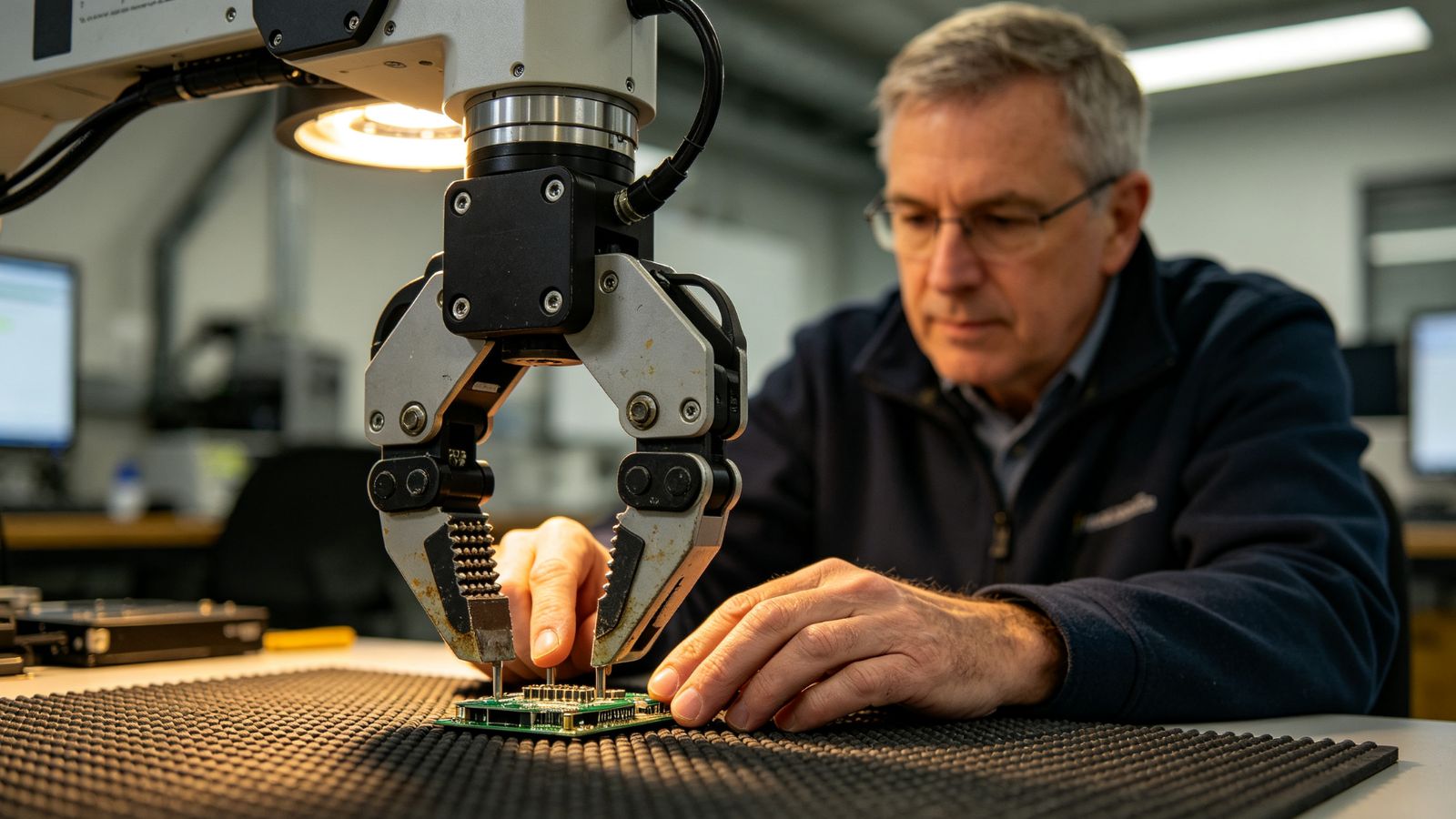
High-resolution tactile sensing introduces costs at almost every layer of the robot. Sensor arrays produce data that must be sampled, filtered, interpreted, and delivered to a controller quickly enough to influence the next physical action. Calibration can change with temperature, material aging, repeated loading, and mechanical wear, so a sensor that performs well during initial testing may require periodic recalibration in long-running applications. Soft sensing surfaces create additional challenges because elastomers can fatigue or develop permanent deformation, changing the relationship between measured signals and actual contact forces. Packaging is another constraint. Wires and electronics must pass through moving joints without becoming a source of mechanical failure, while the sensing surface still needs to remain thin and compliant enough for useful contact. These requirements explain why impressive tactile prototypes do not automatically translate into production-ready hands. A successful system has to balance sensitivity with durability, data quality with processing cost, and mechanical flexibility with the reliability expected from repeated operation.
Uncertainty also limits what tactile feedback can accomplish by itself. The robot may not know the exact coefficient of friction, object mass, center of mass, or internal structure before contact begins. Sensor readings are therefore interpreted through models and estimates rather than treated as perfect measurements. Classical force control can provide a predictable baseline, while learned policies can help map complex tactile patterns to corrective actions when explicit modeling becomes difficult. Hybrid approaches are attractive because they preserve physical constraints while allowing adaptation to objects and contacts that are hard to describe analytically. The same principle applies to system architecture: tactile sensing should complement vision, proprioception, and mechanical compliance rather than become a substitute for them. Reliable manipulation emerges when these sources of information agree well enough to support a timely decision. The engineering challenge is consequently not simply building a more sensitive sensor, but designing a complete loop in which sensing, mechanics, estimation, and control remain useful under real operating conditions.
Tactile sensing is most valuable when the consequences of contact are difficult to predict from vision and geometry alone. A robot handling identical rigid components in a controlled factory may perform adequately with a simple gripper, calibrated force limits, and consistent positioning. The economic value of dense tactile sensing becomes clearer when objects vary in friction, stiffness, shape, or weight, or when the robot must recover from imperfect grasps. Soft packaging, household objects, food, tools, and small assemblies can all produce contact conditions that are difficult to model precisely in advance. In these cases, tactile feedback gives the robot a local measurement of what is actually happening rather than relying entirely on assumptions made before contact. This distinction also helps explain why adding sensors does not automatically improve every robotic system. If the task is already highly repeatable, additional tactile information may add cost and complexity without changing the outcome. The right question is therefore not whether a robot has tactile sensing, but whether contact uncertainty is important enough to justify it.
This task-based perspective changes how fine motor skill should be evaluated. A robot that can grasp a known object repeatedly from a fixed presentation point has demonstrated repeatable grasping, but that is different from adapting to objects whose properties are uncertain. A more demanding system must establish contact, recognize whether the grasp is stable, adjust force when necessary, and continue manipulating without losing control. That requires more than a tactile sensor because the mechanical hand, actuators, state estimator, and controller all have to respond within compatible time scales. It also explains why human-like dexterity remains difficult: human hands combine compliant structures, many degrees of freedom, multiple sensory modalities, rapid feedback, and learned strategies developed through repeated interaction. Robotic systems can reproduce parts of that architecture, but each additional capability introduces its own engineering compromises. Progress therefore depends less on adding a single breakthrough component than on integrating sensing and mechanics into a control system that can make useful decisions from imperfect contact information.
Tactile feedback changes robotic manipulation by giving the controller information that becomes available only when physical contact occurs. Vision can estimate where an object is, while tactile sensing can help determine whether the fingers actually contacted the intended surfaces, how forces are distributed, and whether the object is beginning to move relative to the hand. Mechanical compliance then provides a way to accommodate small errors, and adaptive control uses the combined information to adjust force or motion. None of these elements is sufficient on its own. A sensitive sensor cannot compensate for a poorly designed hand, and a highly capable actuator cannot infer every contact condition without useful measurements. The practical goal is a closed loop in which the robot senses contact, estimates the state of the grasp, selects an appropriate response, and checks the result. That loop is what turns gripping from a fixed mechanical action into an adaptive manipulation process.
The most promising path toward more capable robotic hands is therefore not simply higher sensor resolution or more degrees of freedom. It is better coordination among perception, tactile sensing, mechanical compliance, actuation, and control. Some applications will benefit from simple tactile switches or force sensors, while others may justify dense tactile skins and multimodal sensing because contact uncertainty dominates the task. The useful benchmark is whether the added information enables the robot to perform a task more reliably, recover from errors, or handle a wider range of objects without excessive mechanical complexity. As robotic manipulation moves into less structured environments, that distinction will become increasingly important. Fine motor skill is ultimately an interaction problem: the robot has to understand not only what an object looks like, but also what happens when its fingers touch, press, slide, and move it. Tactile feedback provides one of the clearest ways to close that gap.