
Decoding the technologies of tomorrow, today.
Exploring the breakthrough innovations shaping our world. From AI infrastructure and robotics to biotech, quantum computing, and spatial tech.
Exploring the breakthrough innovations shaping our world. From AI infrastructure and robotics to biotech, quantum computing, and spatial tech.
Training robots directly on physical hardware is expensive because every experiment consumes machine time, equipment availability, energy, and engineering effort. A failed trial may require manual resets, interrupt testing, or damage components.
Sim-to-real transfer provides an alternative development approach. Instead of relying entirely on physical robots to discover behaviors through repeated trial and error, engineers can train and evaluate robotic systems inside simulated environments before transferring selected models or control policies to real machines.
Real-world testing remains necessary because physical systems always contain variables that are difficult to reproduce completely in simulation. However, simulation can move many repetitive experiments into virtual environments where trials can be restarted quickly, conditions can be adjusted systematically, and large numbers of scenarios can be tested without continuously occupying physical hardware.
Two techniques are central to this process: physics-based simulation, which models how robots interact with the physical world, and domain randomization, which helps reduce the gap between simulation and reality.
A robot learning a task must handle much more than programmed movements. Real-world performance depends on motor limitations, surface friction, object properties, sensor noise, and timing delays.
For reinforcement learning and other data-intensive approaches, robots may require thousands or millions of interactions before developing useful behaviors. Collecting these experiences on real hardware creates several challenges:
Robots can only perform a limited number of experiments at one time.
Engineers may need to supervise failures and reset environments.
Hardware experiences mechanical wear during repeated trials.
Some situations are difficult or risky to reproduce physically.
Simulation changes the structure of experimentation. A virtual robot can be reset immediately, exposed to unusual conditions, and tested across many variations without damaging equipment.
The benefit is not only reduced hardware usage. Simulation also allows engineers to explore situations that would be slow, expensive, or impractical to reproduce repeatedly on physical machines.
However, simulation remains an approximation of reality. Differences in contact forces, friction, actuator behavior, sensors, and timing can create a reality gap between virtual training and physical performance.
A physics-based simulator attempts to reproduce the physical relationships that determine how a robot moves and interacts with its surroundings.
Depending on the application, simulation environments may include:
Robot geometry
Mass and inertia
Joint limits
Gravity
Collision behavior
Surface friction
Actuator characteristics
Cameras and other sensors
A visually realistic model alone is insufficient; the simulation must accurately represent the physical factors that influence robot performance.
For example, a robotic arm learning to grasp objects may require accurate modeling of object weight, friction, and contact forces. A mobile robot may depend more heavily on sensor behavior, environmental layouts, and changing conditions.
Two widely used robotics simulation platforms are NVIDIA Isaac Sim and MuJoCo.
NVIDIA Isaac Sim supports robotics simulation, synthetic data generation, testing, and virtual environments connected to robot-learning workflows. MuJoCo is designed for simulating articulated systems and physical interactions for robotics, control, and machine-learning research.
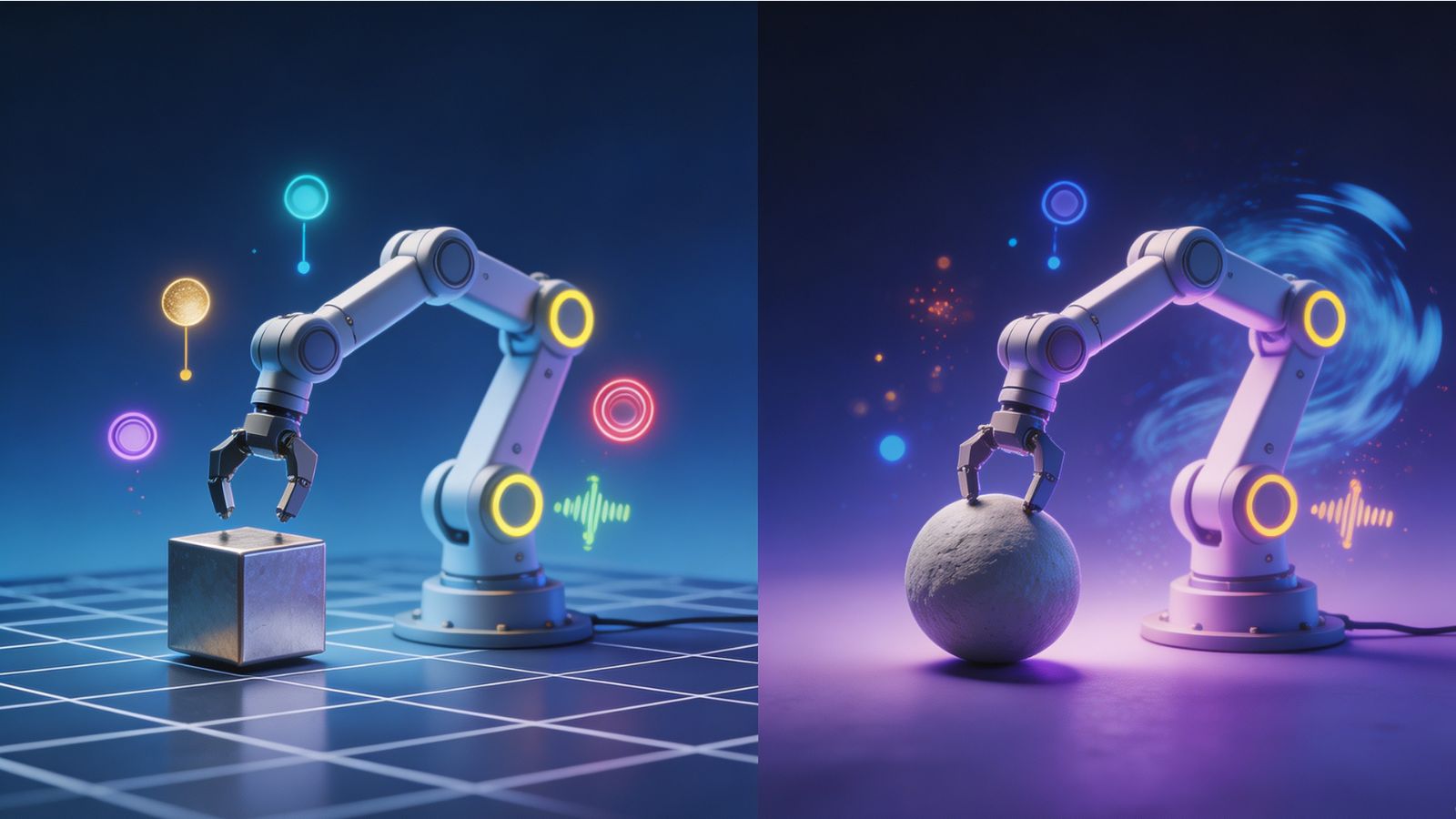
Creating a simulator that perfectly matches the real world is extremely difficult. Many physical variables are uncertain, change over time, or are expensive to measure precisely.
Domain randomization addresses this challenge by deliberately varying simulation conditions during training.
Common randomized factors include:
Object size, shape, and weight
Surface friction
Joint properties
Actuator delays
Sensor noise
Camera position
Lighting conditions
External disturbances
This approach reduces the chance that a robot learns behaviors that only work under one specific simulated condition.
For example, a grasping robot trained with only one object weight and one camera position may fail when those conditions change in reality. A system exposed to a wider range of realistic variations during training may transfer more effectively to physical hardware.
Research reviews describe domain randomization as a method for preventing learning systems from becoming overly specialized to a single simulator configuration.
Effective randomization focuses on realistic uncertainty, exposing robots to conditions they are likely to encounter after deployment.
One influential 2017 OpenAI study investigated dynamics randomization for robotic control. Researchers trained a robotic arm in simulation while varying physical parameters and demonstrated that the resulting policy could transfer to a real robot despite differences between simulated and real dynamics.
Another OpenAI study examined domain randomization for robotic grasping. Researchers generated millions of procedurally created simulated objects and trained a grasping system without relying on traditional real-object training data. In their evaluation, the system achieved an 80% success rate on the tested real-world grasp attempts.
This result applies only to that specific experimental setup and should not be interpreted as a general success rate for all robotic grasping systems. It demonstrates that carefully designed simulation environments can reduce the amount of physical training data required for certain robot-learning tasks.
Sim-to-real transfer is especially useful when robots need to experience many variations but collecting those experiences physically would be slow, expensive, or difficult.
Warehouse robots often operate in environments where objects, layouts, and operating conditions change frequently.
Simulation allows developers to test navigation systems, object handling strategies, and robotic picking behaviors across many virtual scenarios before deploying updates to real facilities.
Manufacturing robots perform tasks such as assembly, sorting, inspection, and material handling.
Simulation allows engineers to evaluate movements, optimize control strategies, and test system changes before modifying production equipment, reducing disruption to active operations.
Autonomous systems must handle many environmental conditions, including rare situations that are difficult to collect safely in the real world.
Simulation expands testing coverage by allowing developers to evaluate perception and decision-making systems under controlled variations such as different lighting, weather conditions, layouts, and obstacles.
Humanoid robots require complex coordination involving balance, walking, manipulation, and recovery from unexpected movements.
Simulation provides additional opportunities to train and test these behaviors without repeatedly risking physical hardware during early development.
Robotic picking is one of the clearest examples of where sim-to-real transfer can reduce development challenges.
A picking robot must identify objects, estimate their position, select an appropriate grasp, and control movement accurately. Even simple tasks can involve many variations in object shape, weight, placement, and lighting.
A robotic picking system typically performs several connected steps:
Detect objects using cameras or other sensors
Estimate object location and orientation
Select a suitable grasp point
Move the robot arm accurately
Adjust actions when objects differ from previous examples
Small changes in object properties can determine whether a grasp succeeds or fails.
Training a picking robot directly in the real world requires many physical examples.
Engineers may need to repeatedly place objects, collect sensor observations, monitor failures, and reset the workspace after unsuccessful attempts.
The challenge becomes larger when the system must handle:
Different object shapes
Different weights and materials
Changing lighting conditions
Different camera viewpoints
Unexpected object positions
Creating this level of variation manually can require significant hardware time and engineering effort.
A simulated picking environment allows developers to generate many variations automatically.
Objects can be changed in size, shape, texture, weight, and position. Developers can also introduce sensor noise, camera changes, and environmental variations through domain randomization.
Instead of collecting every possible situation physically, engineers can first train models using large amounts of simulated experience.
Simulation reduces cost mainly by reducing expensive physical interactions, not by eliminating engineering work. Physical robots are still needed for validation, calibration, and collecting targeted data from situations where simulation is less reliable.
Simulation-trained systems still require testing on real hardware.
Engineers evaluate whether the transferred policy performs reliably by comparing simulated predictions with physical results.
Important validation areas include:
Grasp success under different conditions
Differences in object friction or weight
Sensor accuracy
Unexpected failures that appear only in real environments
The results help engineers identify inaccurate assumptions, improve simulation parameters, and decide where additional real-world testing is needed.
This workflow demonstrates the practical role of sim-to-real transfer: simulation handles large-scale experimentation, while physical robots provide validation and refinement.
Simulation reduces costs primarily by reducing the number of expensive physical interactions required during development.
It does not remove engineering work. Building simulation environments, calibrating models, running experiments, and analyzing results still require skilled teams.
However, simulation can reduce how often developers need physical robots for repetitive experiments.
The main cost advantages usually come from five areas.
Physical robots are expensive assets. Training directly on hardware limits how many experiments can run and increases mechanical wear.
Simulation allows early experiments to happen without continuously occupying physical machines.
For example, a developer testing a robotic arm may evaluate thousands of object positions or control variations in simulation before selecting a smaller group of approaches for physical testing.
This allows hardware time to focus on higher-value experiments rather than repetitive trial generation.
Many robot-learning tasks require repeated setup changes.
A failed physical experiment may require an engineer to reposition objects, restore equipment, or remove errors before another attempt.
Simulated environments can usually restart automatically. A robot can fail, return to its starting state, and immediately attempt another trial.
For tasks requiring large numbers of repetitions, reducing manual intervention can significantly improve development efficiency.
Collecting diverse real-world training data can be one of the slowest parts of robotics development.
A robot learning to grasp objects, for example, may need examples covering different shapes, weights, positions, lighting conditions, and sensor inputs.
Generating this diversity physically requires repeated experiments and engineering supervision.
Simulation allows developers to create controlled variations at scale. Synthetic data does not replace all real-world data, but it can reduce the amount of physical data required for some applications.
Some robot behaviors are difficult to test because failures may damage equipment.
Simulation allows engineers to explore challenging situations before attempting them on physical systems.
Examples include:
Recovering from unstable movements
Handling unexpected object positions
Testing collision scenarios
Evaluating behavior under unusual environmental conditions
Virtual failures provide useful information without consuming physical hardware.
Robot development often involves repeated cycles:
Build a model
Test behavior
Identify problems
Modify the system
Test again
When every iteration depends entirely on physical hardware, progress can be limited by equipment availability and setup time.
Simulation allows teams to evaluate more ideas earlier in development, helping them identify promising approaches before committing resources to physical prototypes.
Simulation is not automatically cheaper for every robotics project.
Creating a useful virtual environment requires engineering effort. Developers may need to create digital assets, estimate physical properties, configure sensors, validate contact behavior, and maintain simulation systems as the physical robot changes.
There are also computing costs. Large-scale simulation training can require significant resources, especially for complex environments involving high-resolution sensor data or many parallel training scenarios.
Domain randomization also requires careful design.
If the variation range is too narrow, the robot may still learn behaviors that only work in simulation.
If the variation range is too broad, training may include unrealistic conditions that slow learning or reduce performance.
For this reason, effective sim-to-real workflows usually focus on meaningful uncertainty rather than randomizing every possible parameter.
Simulation tends to provide the greatest benefit when:
Robots require many repeated trials
Hardware testing is slow or expensive
Failures are costly
Large amounts of training data are needed
Important sources of uncertainty can be modeled
For tasks where real-world behavior is difficult to represent accurately, physical testing may remain the more practical approach.
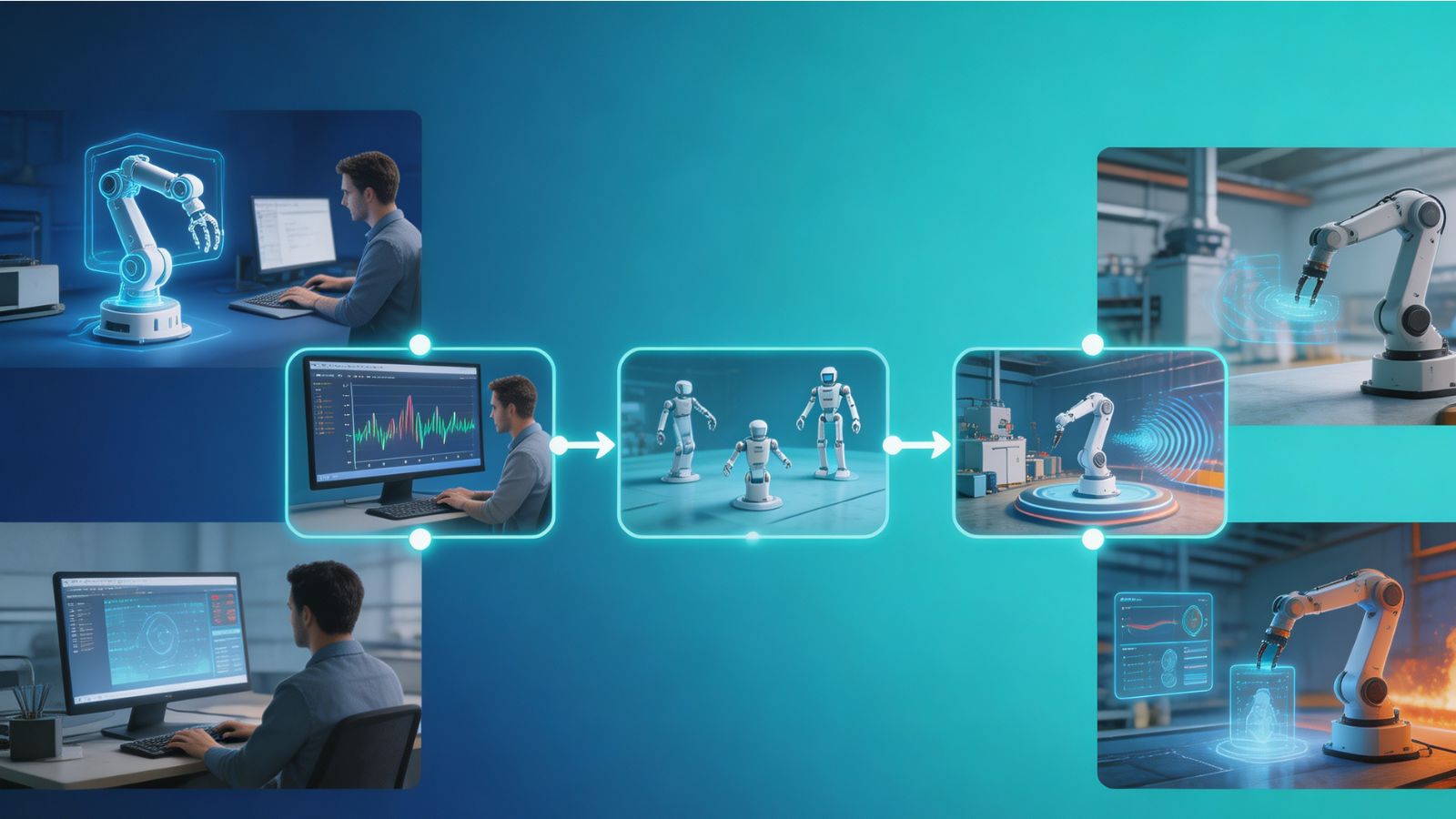
A typical sim-to-real development process includes several stages.
Develop a digital model containing robot geometry, physical properties, sensors, and actuators.
Existing engineering models can reduce development effort, but the simulation still needs to be compared against the physical machine.
Not every detail requires equal modeling effort.
For a grasping robot, friction, object weight, and contact behavior may matter more than highly detailed visual textures.
For autonomous systems, sensor characteristics and environmental variation may have greater influence.
The most effective simulations focus resources on factors that directly affect task performance.
Developers introduce realistic uncertainty in areas such as:
Object properties
Sensor noise
Lighting variation
Actuator behavior
External disturbances
The purpose is to expose robots to conditions they may encounter after deployment.
Large numbers of virtual experiments can reveal weaknesses before physical deployment.
Engineers can evaluate different approaches, test difficult scenarios, and compare system behavior without repeatedly using physical equipment.
Simulation-trained policies are then evaluated on physical robots.
Engineers compare real performance with simulation predictions and identify differences caused by modeling errors or unexpected environmental factors.
Real-world testing provides information that improves future simulations.
If a robot behaves differently from expected, developers can adjust physics parameters, sensor models, or randomization ranges.
The process is iterative:
simulate → train → test → transfer → validate → refine
Sim-to-real transfer can reduce robot training and development costs by moving large amounts of repetitive experimentation into controlled simulation environments.
Physics-based simulation provides a structured way to model robot interactions, while domain randomization helps improve robustness when transferring learned behaviors to physical machines.
Research has demonstrated successful transfer in specific tasks such as robotic pushing and grasping, and modern simulation platforms continue to expand the use of synthetic data and large-scale robot training.
The strongest applications are those where simulation can handle extensive experimentation while physical robots are reserved for validation, calibration, and situations that require real-world testing.