
Decoding the technologies of tomorrow, today.
Exploring the breakthrough innovations shaping our world. From AI infrastructure and robotics to biotech, quantum computing, and spatial tech.
Exploring the breakthrough innovations shaping our world. From AI infrastructure and robotics to biotech, quantum computing, and spatial tech.
Humanoid robots have moved from research laboratories toward commercial development, driven by advances in artificial intelligence, robotics hardware, and industrial automation. Their human-like form provides potential advantages in environments designed for people, including factories, warehouses, and service applications.
However, building a working prototype and building a commercially scalable product are two very different challenges.
A prototype humanoid robot can rely on skilled engineers, custom-machined parts, manual calibration, and limited production volume. Commercial manufacturing requires something much more demanding: consistent performance, reliable supply chains, predictable costs, and repeatable production processes.
The challenge extends far beyond software. A humanoid robot is a complex hardware system containing precision mechanical structures, high-performance actuators, sensors, batteries, electronics, and control systems. Each subsystem must be manufactured and integrated at a scale that traditional robotics production has rarely required.
A humanoid robot depends on mechanical precision because its movement, balance, and energy efficiency are directly affected by the accuracy of its physical components.
Unlike conventional industrial robots that often operate within controlled workspaces, humanoid robots must coordinate many joints while maintaining stability during walking, manipulation, and interaction with changing environments. This creates demanding requirements for structural components, transmission systems, and actuator assemblies.
One major challenge is the production of compact actuators. Humanoid robots typically require many degrees of freedom, meaning each joint must provide controlled movement while remaining lightweight and efficient.
Creating smaller motors, precision gear reducers such as harmonic drives and cycloidal gears, and Quasi-Direct Drive (QDD) actuators that deliver high torque in limited space requires advanced manufacturing capabilities.
Harmonic drives, also known as strain-wave gears, are widely used in robotics because they provide high reduction ratios, compact size, and low backlash. Their manufacturing requires extremely precise machining because small dimensional errors can affect efficiency, positioning accuracy, and durability.
Cycloidal gear systems provide another approach for robotic transmissions. They can deliver high torque density and impact resistance, making them suitable for applications where robots may experience dynamic loads.
Quasi-Direct Drive (QDD) actuators represent a different design approach by combining high-torque motors with lower gear reduction ratios. This improves backdrivability and force control, which can be valuable for robots operating around people or handling unpredictable interactions.
Scaling these technologies from prototype quantities to commercial production requires more than accurate machining. Manufacturers must develop repeatable processes involving CNC machining, precision grinding, surface treatment, automated inspection, and quality control systems.
Prototype production can often rely on skilled technicians who compensate for small variations manually. Commercial manufacturing requires those variations to be minimized through process control and consistent supplier performance.
The central challenge is finding the right balance between mechanical precision and manufacturing cost. Extremely high-precision aerospace-style manufacturing methods may produce excellent components, but they may not be economically practical for large-scale humanoid robot production.
The supply chain for a humanoid robot is significantly more complex than that of many traditional industrial machines.
A commercial humanoid robot combines mechanical components, semiconductor systems, sensors, batteries, motors, precision transmissions, and software-controlled electronics. Each category involves different suppliers, manufacturing capabilities, and quality requirements.
Actuator components represent one of the most important supply chain challenges. A humanoid robot may require dozens of compact motors and precision gear systems. These components must deliver reliable performance over long operating periods while maintaining low weight and energy consumption.
Battery systems create another challenge. Mobile humanoid robots require energy storage solutions that provide sufficient operating time while meeting safety and durability requirements. Battery manufacturing capacity is already influenced by demand from electric vehicles and energy storage applications.
Electronic components introduce additional complexity. Modern robots depend on processors, motor controllers, communication chips, and sensors. Global semiconductor disruptions demonstrated how dependent advanced manufacturing has become on stable electronics supply networks.
To reduce supply chain risks, manufacturers are exploring strategies including supplier diversification, standardized components, strategic partnerships, and selective vertical integration of critical technologies.
However, greater control over the supply chain also increases investment requirements. Companies must decide which components should be manufactured internally and which should come from specialized suppliers.
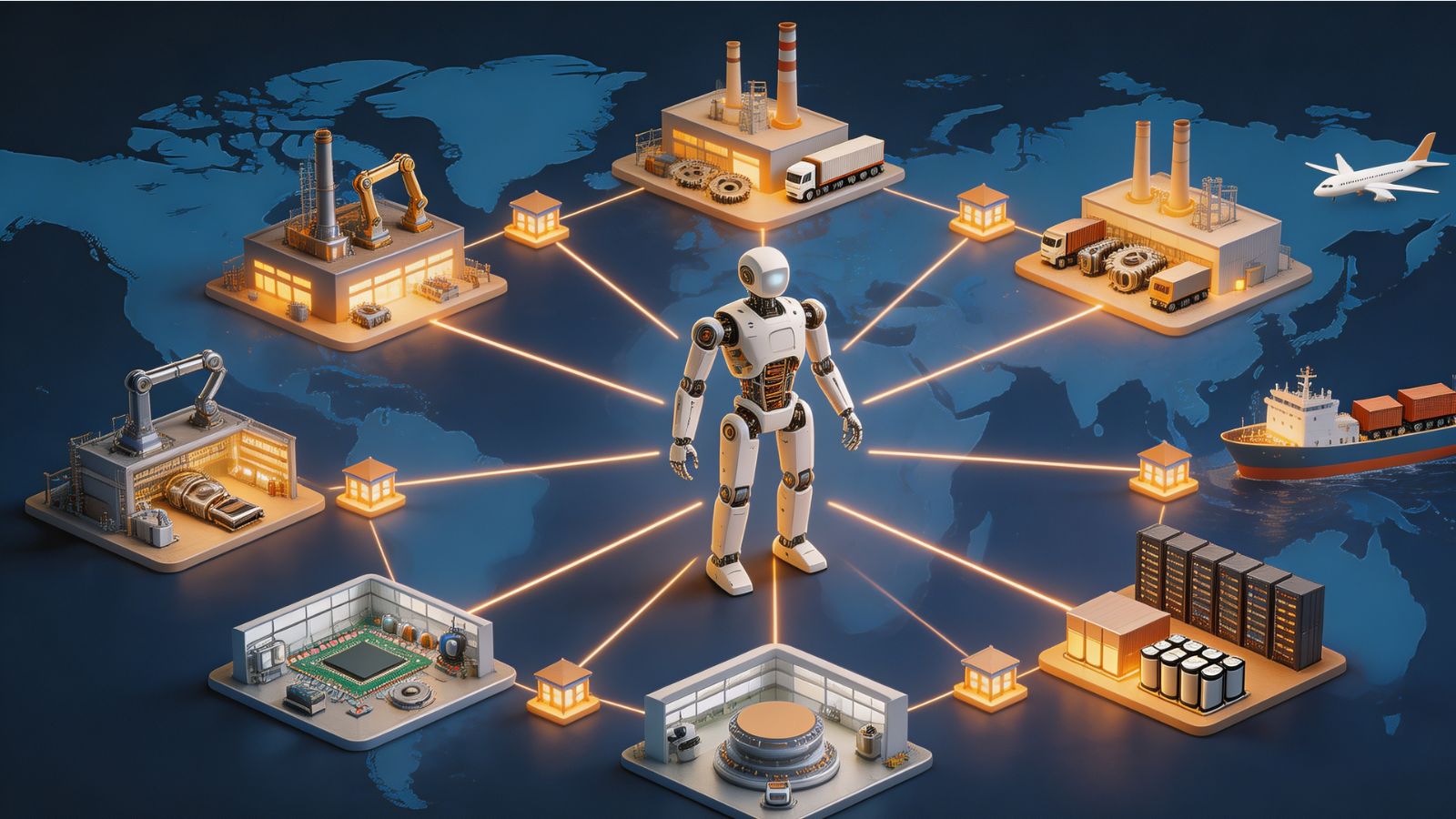
Assembly represents one of the largest differences between laboratory prototypes and commercial humanoid robots.
Prototype robots are often built by engineering teams who understand every component and can manually adjust systems during assembly. This approach is effective for research and early demonstrations because engineers can compensate for small mechanical variations, tune software parameters, and modify components during testing.
Commercial production requires a completely different manufacturing approach. Instead of relying on individual expertise, manufacturers need standardized assembly procedures, repeatable component installation, automated inspection systems, and documented quality control processes.
The difference between prototype development and commercial manufacturing is mainly reflected in consistency. Prototype systems can tolerate a certain level of variation because engineers may manually calibrate individual robots after assembly. In mass production, this approach becomes inefficient because every unit must achieve predictable performance with minimal manual adjustment.
Supply chain requirements also change significantly. Prototype development often depends on custom parts, small-batch purchasing, and multiple temporary suppliers. Commercial manufacturing requires standardized components, qualified long-term suppliers, and stable production processes that can support larger volumes.
Quality control becomes more demanding as production scales. A prototype may only require basic functional testing, such as verifying movement and software operation. Commercial humanoid robots require more comprehensive validation, including actuator calibration, sensor verification, mechanical alignment checks, battery system testing, and long-term reliability evaluation.
The design philosophy must also change. Prototype robots are often optimized for demonstrating technical capability and achieving advanced movement performance. Commercial robots must additionally follow Design for Manufacturing (DFM) and Design for Assembly (DFA) principles, where engineers consider production cost, assembly complexity, maintenance requirements, and scalability during the design stage.
This transition requires manufacturers to rethink robot architecture itself. A component that performs well in a prototype may not be suitable for large-scale production if it requires excessive manual labor, complex calibration procedures, or specialized assembly skills.
For humanoid robots to become commercially viable, manufacturing efficiency must become part of the engineering design process rather than a separate step after development.
Several companies developing humanoid robots are facing the same transition from prototype engineering to scalable manufacturing.
Tesla has presented its Optimus humanoid robot as part of its broader robotics strategy, combining experience from electric vehicles, battery systems, and automated manufacturing.
The manufacturing challenge for a humanoid robot differs from vehicle production because robots require many compact precision components, complex motion systems, and highly integrated electronics.
Tesla’s experience with automotive manufacturing may provide advantages in factory automation, supply chain management, and production processes. However, humanoid robots require specialized robotics manufacturing capabilities that differ from traditional vehicle assembly.
Figure AI is developing humanoid robots designed for commercial applications where robots can assist with physical tasks.
The company’s development approach highlights the challenge of integrating artificial intelligence with reliable mechanical hardware. For humanoid robots to operate in real workplaces, manufacturers must solve not only autonomy and perception problems but also durability, maintenance, component reliability, and production scalability.
Agility Robotics has focused on humanoid robots designed for industrial and logistics environments. Its Digit robot demonstrates how humanoid-style systems can be developed around specific workplace applications.
The manufacturing challenge involves producing robots that can operate reliably in commercial settings while maintaining reasonable production costs and service requirements.
Apptronik is developing humanoid robotic systems with a focus on industrial applications. Its work demonstrates another important aspect of commercialization: creating robotic platforms that can be manufactured, maintained, and adapted for practical workplace tasks.
Across these companies, the common challenge is not only creating robots capable of movement and interaction. The larger challenge is developing a manufacturing system capable of producing complex robots consistently.
Manufacturing considerations must be included during robot design rather than added after development.
A robot designed only for maximum performance may become difficult and expensive to produce. Engineers must consider how easily components can be machined, assembled, inspected, repaired, and replaced.
Design for Manufacturing (DFM) and Design for Assembly (DFA) principles are increasingly important in robotics development. These approaches encourage engineers to reduce unnecessary complexity, standardize components, and simplify production workflows.
Modular hardware architectures are one possible solution. Shared components across different robot models can reduce inventory complexity and improve production efficiency.
However, modularity also introduces trade-offs. More interfaces can increase potential failure points and require additional testing. The goal is not maximum modularity but the right balance between flexibility, reliability, and manufacturing efficiency.
The progress of humanoid robots is often measured by improvements in artificial intelligence, perception systems, and autonomous decision-making. However, commercial deployment may depend equally on a less visible challenge: the ability to manufacture complex robotic hardware consistently and economically.
AI systems can improve rapidly through software updates and new training methods. Hardware development follows a different path. A humanoid robot requires precision-machined components, reliable actuators, durable mechanical structures, battery systems, and carefully integrated electronics. Each improvement must eventually be converted into a repeatable manufacturing process.
This creates a potential gap between technological demonstrations and commercial production. A robot may successfully perform tasks in controlled environments, but producing large numbers of identical systems requires mature suppliers, stable component specifications, and manufacturing processes capable of maintaining quality over time.
Supply chain maturity is another important factor. Humanoid robots combine technologies from several industries, including robotics, automotive manufacturing, semiconductor production, and energy storage. Developing a complete ecosystem of qualified suppliers may take years, especially for specialized components such as robotic actuators and precision transmissions.
For this reason, manufacturing capability may become one of the primary factors determining which humanoid robot companies successfully move from prototypes to commercial products. The strongest companies may not only be those with advanced AI systems, but also those capable of building reliable production systems around complex mechanical hardware.
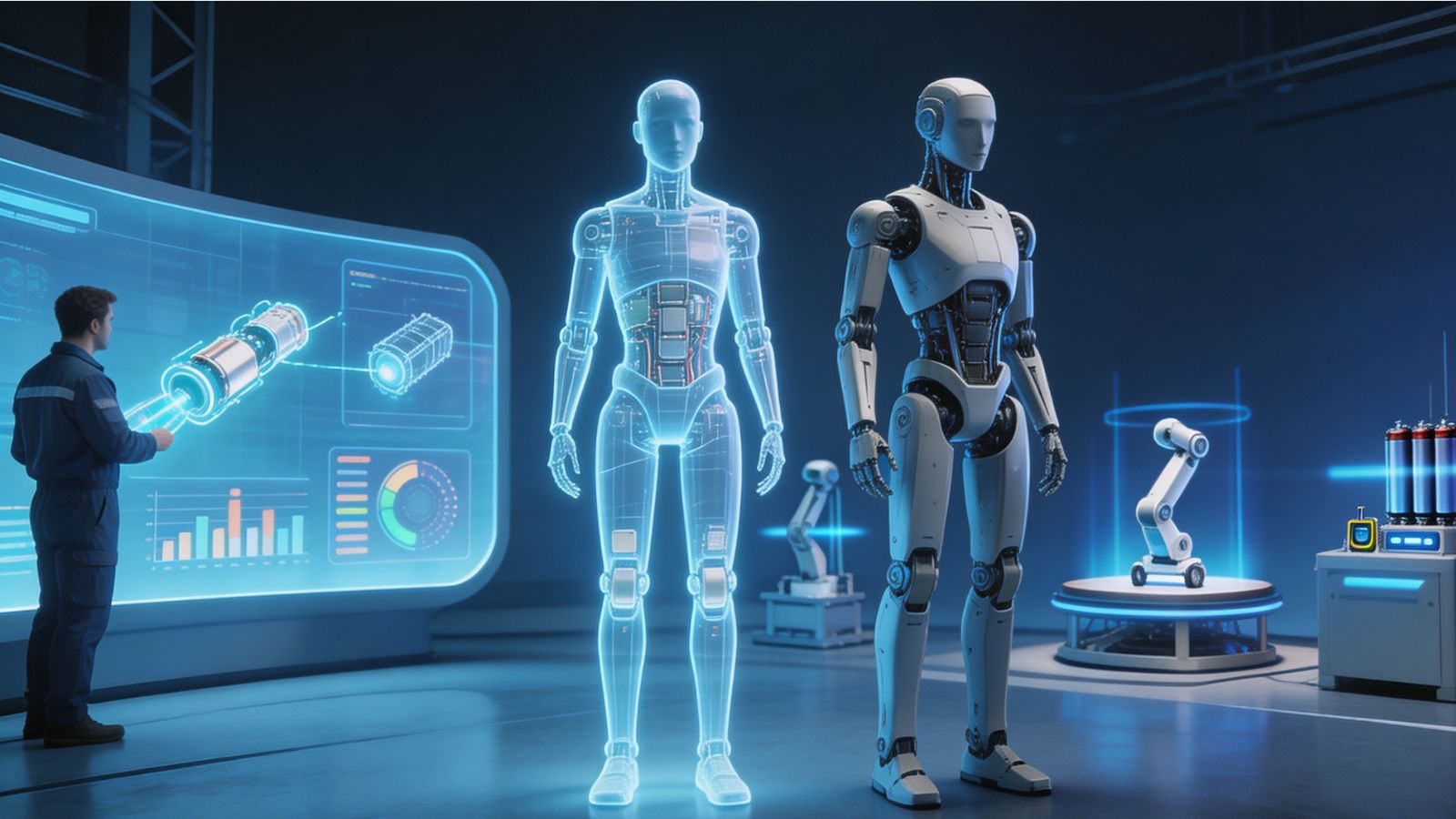
Scaling humanoid robot production will likely require advanced manufacturing systems that combine automation, data management, and continuous quality improvement.
Digital manufacturing technologies can connect product design data, supplier information, factory operations, and inspection results. Digital twins and simulation tools can help engineers identify production problems before physical manufacturing begins.
Automated testing will also become increasingly important. Humanoid robots require validation not only of individual components but also of complete system behavior, including joint performance, balance control, sensor communication, battery operation, and software integration.
At the same time, early humanoid robot factories may require flexible manufacturing systems rather than traditional high-volume production lines. Robot designs are still evolving rapidly, and manufacturers need production environments that can adapt to hardware improvements.
The future of humanoid robots depends not only on artificial intelligence capabilities but also on manufacturing execution.
A small number of expensive prototypes can demonstrate technical possibilities, but widespread adoption requires reliable production, manageable costs, and long-term service support.
Industries such as manufacturing, logistics, and warehouse operations may become important application areas for humanoid robots. Achieving this goal requires solving manufacturing challenges as carefully as software and robotics challenges.
The transition from prototype to scalable production is often where emerging technologies succeed or fail. For humanoid robots, precision machining, supply chain stability, and assembly efficiency will determine whether these machines remain specialized demonstrations or become practical tools used across industries.
As manufacturers improve production methods, the focus will shift from simply creating humanoid robots to building them efficiently, reliably, and at a scale that supports real-world deployment.