
Decoding the technologies of tomorrow, today.
Exploring the breakthrough innovations shaping our world. From AI infrastructure and robotics to biotech, quantum computing, and spatial tech.
Exploring the breakthrough innovations shaping our world. From AI infrastructure and robotics to biotech, quantum computing, and spatial tech.
A general-purpose language model can answer questions, summarize documents, classify text, and generate content without knowing anything about a particular organization's internal operations. The challenge begins when an AI application needs specialized knowledge, highly consistent behavior, or both.
A customer-support assistant may need access to current product documentation. A research system may need to work with a changing collection of papers. A business application may need the model to follow a specific classification scheme or response style.
Two approaches are commonly considered: retrieval-augmented generation (RAG) and fine-tuning.
They solve different problems. RAG gives a model access to relevant external information when a request is processed. Fine-tuning adapts the model through additional training so it becomes better suited to a particular task, domain, or behavior. The original RAG research specifically combined a pretrained language model with an external retrieval system for knowledge-intensive tasks, while later fine-tuning research has focused on adapting pretrained models to specialized tasks and domains.
The practical question is therefore not simply which technology is better. It is what needs to change: the information available to the model, the model's behavior, or both?
Retrieval-augmented generation was introduced as a way to combine a language model's internal, or parametric, knowledge with information stored in an external knowledge source. In the original RAG research, a retriever selected relevant passages from an external collection and supplied them to a generator for knowledge-intensive tasks.
In a modern application, the basic idea is straightforward.
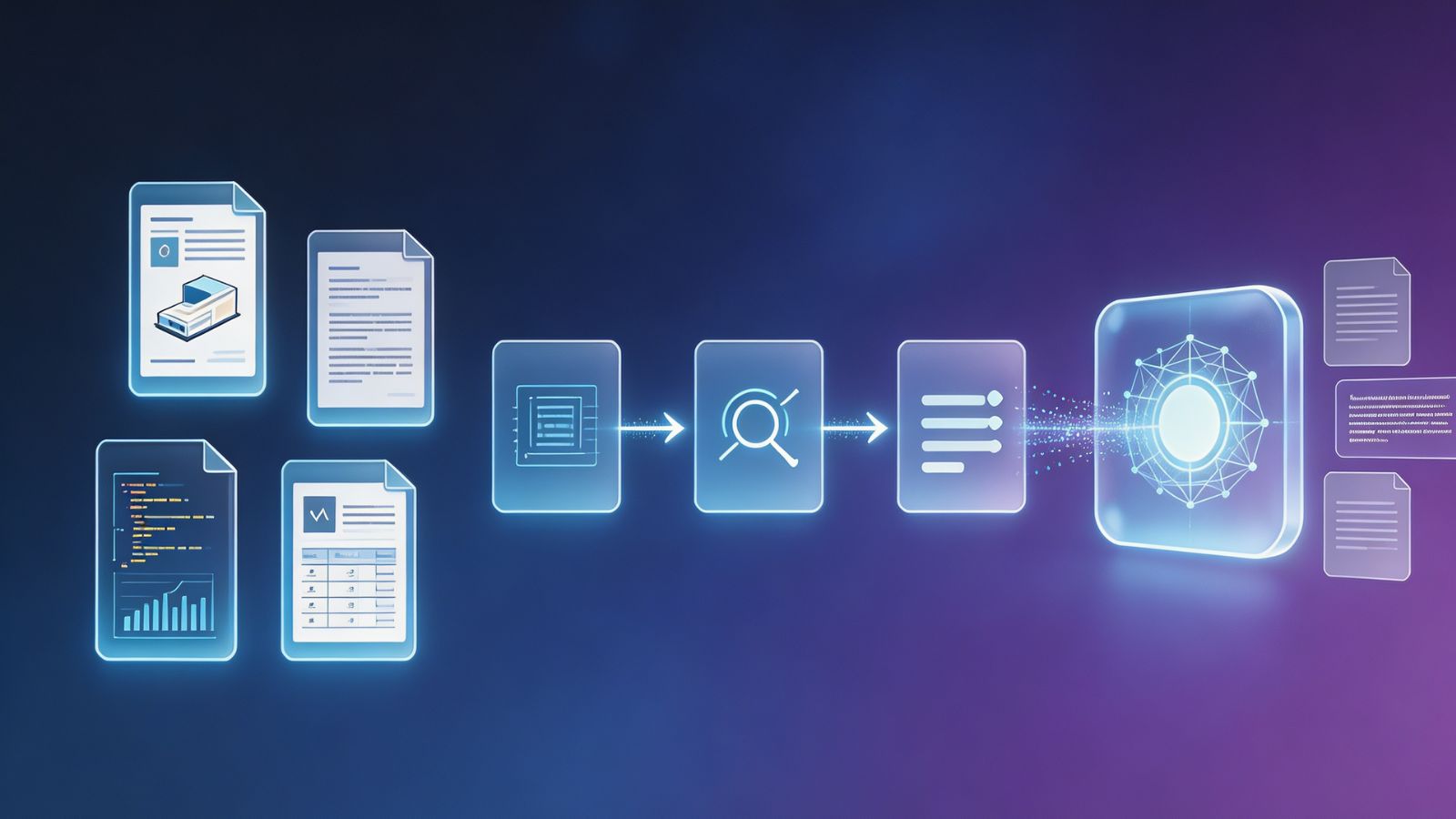
An organization might collect product manuals, internal policies, technical documentation, research papers, or other reference material. The documents are processed and indexed so relevant passages can be found later. When a user asks a question, the application retrieves potentially useful information and supplies it to the language model as context.
The model itself does not need to be retrained every time one of those documents changes.
That is one of RAG's strongest advantages.
If a company changes its return policy, for example, developers can update the knowledge base rather than retraining the language model to incorporate the new policy.
RAG is therefore particularly useful when specialized information is large, frequently updated, or maintained outside the model.
Fine-tuning takes a different route.
Instead of retrieving information for each request, developers train a pretrained model on examples that represent the desired task or behavior. The training process adjusts model parameters so the resulting model becomes better adapted to those examples.
Traditional full-model fine-tuning can require substantial computational resources. Parameter-efficient fine-tuning (PEFT) methods reduce the amount of the model that needs to be updated, making specialization more practical in situations where computing resources, memory, or training data are constrained. Recent research describes PEFT as an important approach for adapting language models while reducing training and deployment costs.
Fine-tuning can therefore be useful when the problem is not simply a lack of information.
For example, an organization might have thousands of high-quality examples demonstrating how support requests should be classified or how specialized reports should be structured. Those examples can provide training signals for the model's desired behavior.
The distinction is easier to remember this way:
RAG gives an existing model relevant information when it needs it.
Fine-tuning changes the model so that it learns a more specialized way of performing a task.
That difference is more useful than treating RAG and fine-tuning as competing technologies.
Suppose a business wants an AI assistant to answer questions about its employee handbook.
If the handbook changes regularly, RAG is a natural candidate. The application can retrieve the current policy when a question is asked instead of trying to permanently encode every policy detail into the model.
Now consider a different requirement. The company wants the assistant to classify support tickets according to its own categories and consistently follow a particular response style.
That is primarily a behavior problem.
A carefully prepared fine-tuning dataset can teach the model patterns associated with those tasks. Current research on fine-tuning examines its use for domain adaptation, task specialization, and behavior alignment, including situations where only limited training data is available.
This leads to a useful rule:
Use RAG when the model needs better access to information.
Consider fine-tuning when the model needs to learn a different or more consistent way of performing a task.
In more sophisticated systems, both approaches can be used together.
RAG is particularly useful when the information behind an application changes over time.
Typical examples include:
Product documentation: Manuals and specifications can be updated without retraining the model.
Internal policies: Employees can ask questions against a current collection of company policies.
Technical knowledge bases: Troubleshooting information can remain separate from the model itself.
Research collections: New papers or reports can be added to the searchable collection.
Company records: Applications can retrieve relevant information from authorized internal sources.
The original RAG research highlighted the value of combining generation with external knowledge, including the potential to update information and provide more direct grounding for knowledge-intensive answers.
Another practical advantage is that retrieved material can be examined separately from the final response. A well-designed application can show users which documents or passages supported an answer.
That does not make RAG automatically accurate.
A retrieval system can return irrelevant passages. Important information may not be indexed correctly. A model can misunderstand retrieved material or produce a conclusion that is not actually supported by it.
RAG improves access to information; it does not eliminate the need for evaluation.
Fine-tuning becomes more attractive when the desired improvement is primarily behavioral.
Imagine a company with a large collection of high-quality examples showing how a particular classification task should be performed. A fine-tuned model may learn the organization's preferred patterns more consistently than a general model relying entirely on prompts.
Fine-tuning can also be useful for specialized terminology, response formats, tone, and repeatable task behavior when sufficient training examples are available.
But a large document collection is not automatically a good fine-tuning dataset.
If an organization has thousands of changing policies, manuals, and reports, simply using those documents for training does not turn the model into a reliable searchable knowledge base. Training data needs to represent the behavior or task the model is expected to learn.
This is one of the most important distinctions between the two approaches.
RAG is primarily an information-access strategy. Fine-tuning is primarily a model-adaptation strategy.
RAG moves part of the problem outside the language model.
Developers need to determine how documents should be divided, indexed, retrieved, filtered, and ranked. The quality of those steps can have a substantial effect on the final answer.
A powerful language model cannot compensate for a retrieval system that repeatedly supplies irrelevant information.
This means RAG applications often require evaluation at several stages. Developers may need to determine whether the correct document was retrieved, whether the selected passage actually answers the question, and whether the language model used that information correctly.
There is also an operational cost. Documents have to be processed and indexed, indexes need maintenance, and retrieval adds another stage to the application's response pipeline.
For applications where information changes frequently, however, that additional infrastructure can be preferable to repeatedly retraining a model.
Fine-tuning requires appropriate training data, a training process, evaluation, and ongoing model management.
The quality of the examples matters enormously. Inconsistent examples can teach inconsistent behavior, while an overly narrow dataset may fail to generalize to situations outside the training examples.
Another consideration is catastrophic forgetting, in which adaptation can interfere with capabilities learned previously. Recent research identifies catastrophic forgetting, generalization, and data limitations as important considerations when fine-tuning language models.
PEFT techniques can make customization more efficient, but they do not eliminate the need for careful dataset construction and testing. Research on parameter-efficient adaptation has specifically focused on reducing the computational burden of specializing large pretrained models.
Fine-tuning should therefore be viewed as a model-development decision rather than simply a replacement for document retrieval.
Instead of treating RAG and fine-tuning as interchangeable technologies, developers can make the decision by asking what kind of problem they are trying to solve.
The main problem is missing information. The model needs access to private, specialized, or external knowledge.
The information changes frequently. Policies, documentation, product details, and other sources may need regular updates.
Source grounding matters. Users may need to see which documents or passages support an answer.
You want to update knowledge without retraining. Changes can generally be handled through the external knowledge source and retrieval system.
Your primary data consists of documents. The goal is to make relevant material available during generation.
The main problem is model behavior. The model has the necessary information but does not consistently perform the desired task.
You have high-quality examples. Training data demonstrates what successful outputs should look like.
The task is relatively stable. The desired behavior does not need to change every time an underlying document is updated.
Consistency matters. The application needs more predictable task execution, formatting, terminology, or response patterns.
Prompting alone is insufficient. Repeated evaluation shows that additional model adaptation could address the remaining problem.
The model needs specialized behavior and current information.
Fine-tuning can establish a consistent workflow while RAG supplies changing reference material.
Evaluation shows that neither approach alone solves the application's main failure points.
A combination can be powerful, but it also creates a more complicated system. Each additional component requires testing, monitoring, maintenance, and troubleshooting.
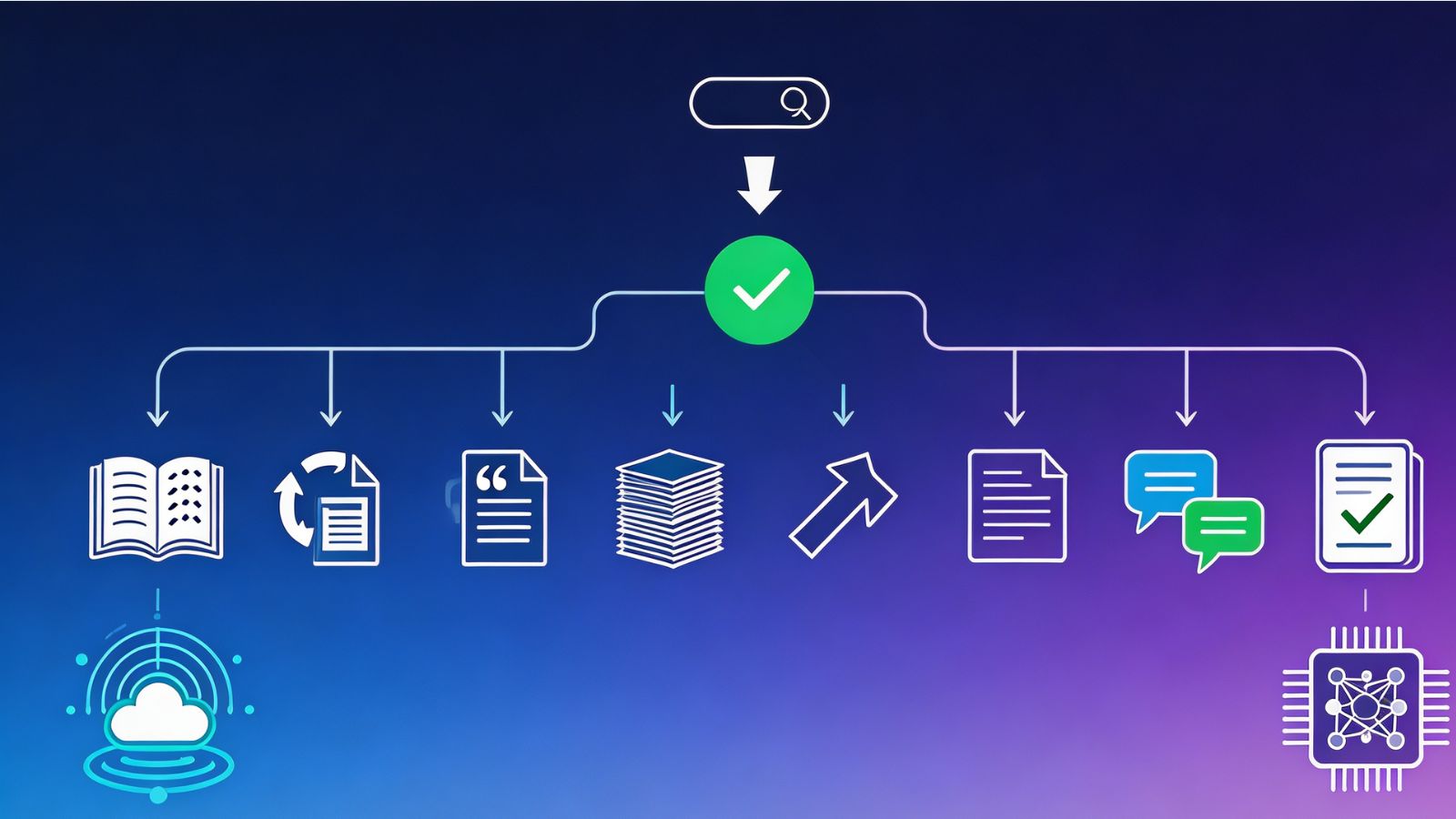
For many teams, the sensible development path is to begin with the least complicated intervention that addresses the observed failure.
If the model produces incorrect answers because it cannot access current company information, test a RAG system.
If the model has access to the necessary information but repeatedly fails to follow a specialized task format, investigate better prompting, workflow design, or fine-tuning.
If retrieval provides the right information but the model consistently uses it poorly, the solution may involve improving retrieval, changing the model, refining instructions, or combining RAG with fine-tuning.
This approach makes evaluation more useful because developers can ask a specific question: Where is the system failing?
That is more productive than asking whether RAG or fine-tuning is universally superior.
RAG versus fine-tuning is often presented as a simple technology comparison, but the underlying distinction is more practical.
RAG changes what information the model can access at response time. Fine-tuning changes how the model has been adapted to perform a task.
If information changes regularly and needs to remain outside the model, retrieval is usually the more natural mechanism. If the information is relatively stable but the model needs to perform a specialized task more consistently, fine-tuning deserves closer consideration.
When an application needs both specialized behavior and current external knowledge, using the two approaches together may be appropriate.
The strongest architecture is not necessarily the one with the most components. It is the one in which every component addresses a demonstrated need.