
Decoding the technologies of tomorrow, today.
Exploring the breakthrough innovations shaping our world. From AI infrastructure and robotics to biotech, quantum computing, and spatial tech.
Exploring the breakthrough innovations shaping our world. From AI infrastructure and robotics to biotech, quantum computing, and spatial tech.
Nuclear fusion has long been considered a potential pathway toward large-scale clean energy because it replicates the process that powers the Sun: combining light atomic nuclei to release energy. Unlike conventional nuclear fission, which splits heavy atoms, fusion combines isotopes such as deuterium and tritium to produce energy with no direct carbon emissions during operation and significantly different waste characteristics.
The promise of fusion is substantial. Fusion fuels are abundant compared with fossil resources, and fusion reactions produce large amounts of energy from relatively small quantities of fuel. However, creating a practical fusion power plant requires overcoming some of the most demanding engineering challenges in modern science.
Fusion reactions require extreme conditions. Plasma fuel must be heated to temperatures exceeding those found in the Sun’s core because fusion devices operate at lower pressures than stellar environments. Engineers must create systems capable of maintaining ultra-hot plasma, extracting energy, protecting reactor materials, and converting fusion output into reliable electricity.
Two major approaches dominate fusion research today: magnetic confinement fusion and inertial confinement fusion. Both have achieved important milestones, but significant technical barriers remain before commercial fusion reactors become a reality.
Fusion occurs when atomic nuclei overcome their natural electrical repulsion and combine into a heavier nucleus. The most widely studied reaction uses deuterium and tritium:
Deuterium + Tritium → Helium + Neutron + Energy
The reaction releases energy because the resulting helium nucleus has slightly less mass than the original particles. The difference is converted into energy according to Einstein’s mass-energy relationship.
For fusion to produce more energy than is consumed, three conditions must be satisfied:
Extremely high plasma temperature
Sufficient plasma density
Adequate confinement time
This combination is known as the Lawson criterion, which describes the conditions required for achieving practical fusion energy output.
Maintaining these conditions simultaneously is the central engineering challenge.
Magnetic confinement fusion uses powerful magnetic fields to contain hot plasma without allowing it to directly touch reactor walls.
Because plasma temperatures can exceed 100 million degrees Celsius, no conventional material can withstand direct contact with the fuel. Magnetic fields act as an invisible barrier, keeping the plasma suspended inside the reactor chamber.
The two most developed magnetic confinement concepts are:
Tokamaks
Stellarators
Tokamaks are currently the most widely researched magnetic fusion devices.
A tokamak uses a doughnut-shaped chamber called a torus. Magnetic fields created by external coils and electrical currents flowing through the plasma work together to confine and stabilize the fusion fuel.
Major tokamak research facilities have demonstrated significant progress in:
Maintaining high-temperature plasma
Extending plasma duration
Improving magnetic control systems
Increasing fusion energy output
Projects such as the international ITER experiment are designed to demonstrate sustained high-performance plasma operation and advance understanding of large-scale fusion engineering.
However, tokamaks face ongoing challenges related to plasma instability. Hot plasma behaves like a complex fluid, and disturbances can cause sudden energy losses or terminate the reaction.
Engineers use advanced sensors, control algorithms, and magnetic adjustment systems to manage these instabilities.
Stellarators use carefully designed external magnetic coils to create twisted magnetic fields that confine plasma without relying on large internal plasma currents.
This design can provide advantages for continuous operation because it reduces certain instability risks associated with tokamaks.
However, stellarators require extremely complex magnetic structures. Manufacturing precise superconducting coils with the required geometry is a major engineering challenge.
Modern computational tools have improved stellarator design, but building commercially practical systems remains difficult because of complexity, cost, and construction requirements.
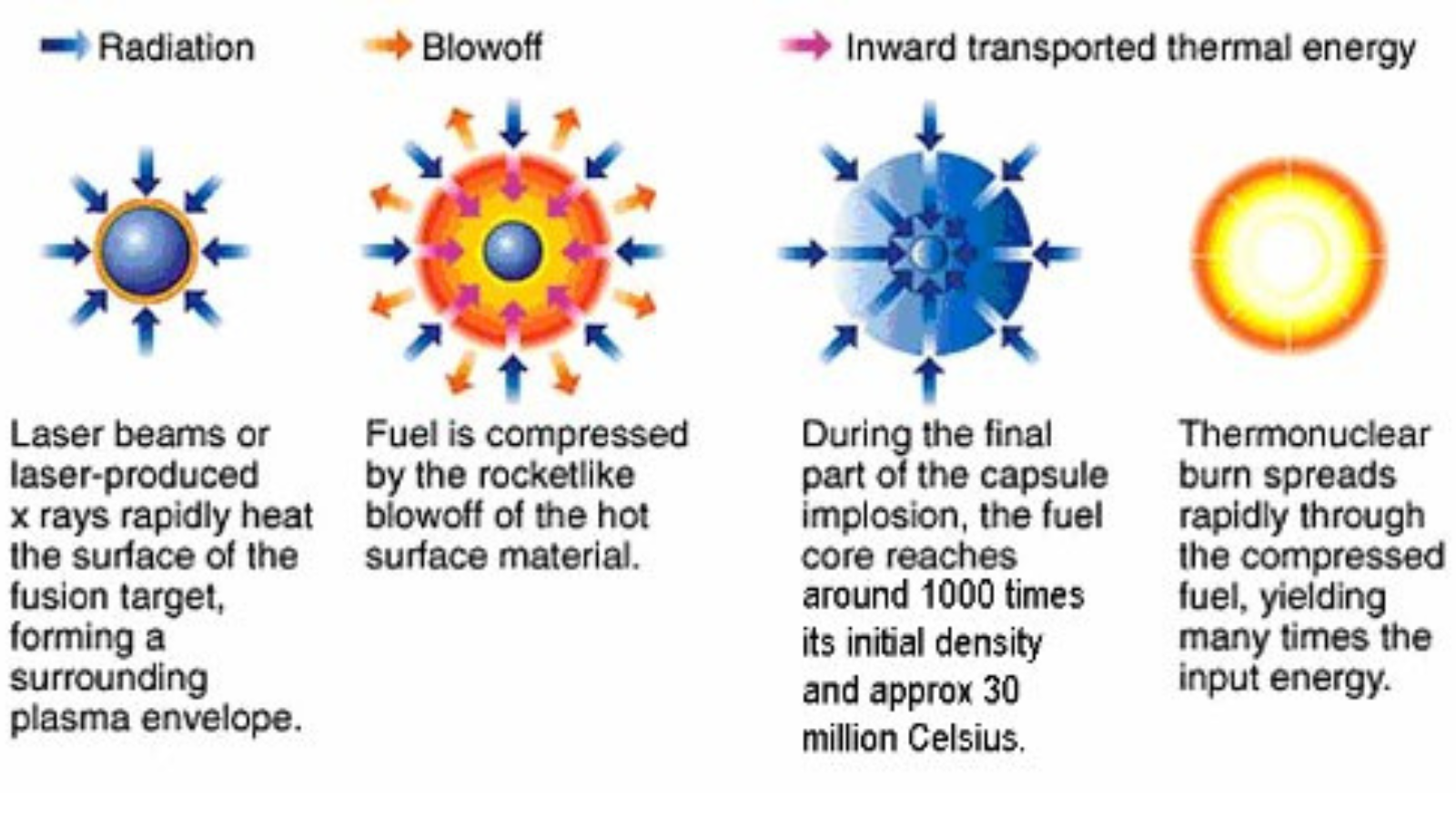
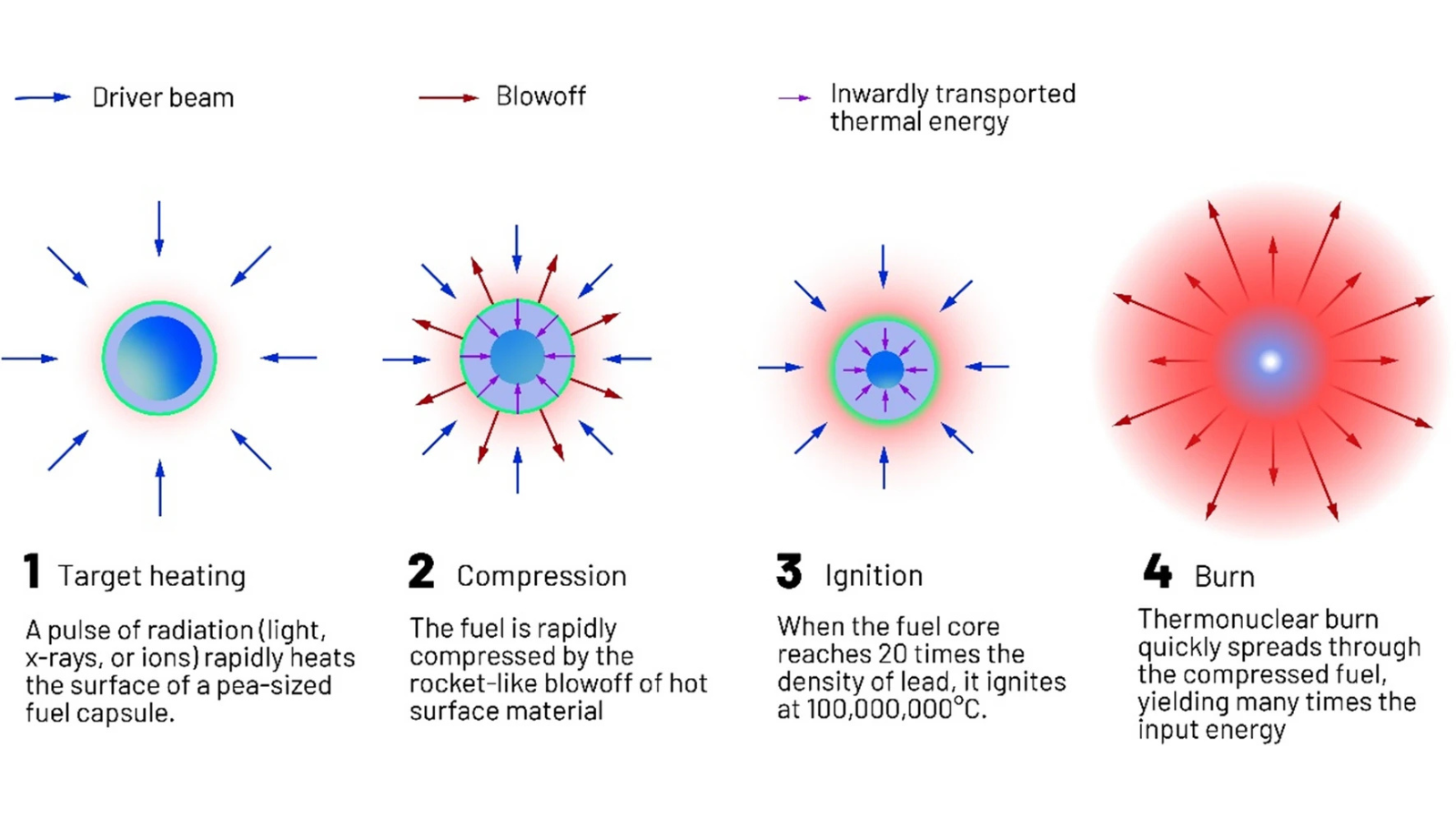
Inertial confinement fusion takes a different approach. Instead of holding plasma for long periods with magnetic fields, it compresses tiny fuel pellets using extremely powerful energy pulses.
The most advanced systems use high-energy lasers directed at small capsules containing fusion fuel.
The energy rapidly compresses and heats the fuel, creating conditions where fusion reactions occur before the material can expand.
A major milestone occurred at the National Ignition Facility, where researchers demonstrated fusion ignition by producing more fusion energy than the laser energy delivered to the target.
This achievement represented an important scientific milestone, but commercial electricity generation requires much more than achieving ignition once.
A commercial fusion reactor must operate very differently from a research experiment.
A power plant would need to:
Produce energy continuously
Replace fuel components efficiently
Maintain reactor materials
Convert fusion heat into electricity
Operate economically
For inertial fusion systems, this means developing laser systems capable of firing repeatedly at high efficiency while producing and positioning thousands of fuel targets per day.
For magnetic fusion systems, it means maintaining stable plasma operation for long periods while managing intense heat and neutron exposure.
One of the greatest obstacles facing commercial fusion is developing materials capable of surviving reactor conditions.
Fusion reactions produce high-energy neutrons that can damage structural materials over time.
These neutrons can cause:
Atomic displacement
Material swelling
Reduced mechanical strength
Changes in chemical properties
Reactor components near the plasma must withstand extreme combinations of:
High temperatures
Radiation exposure
Mechanical stress
Repeated thermal cycling
Researchers are investigating advanced materials, including:
Reduced-activation steels
Tungsten-based components
Ceramic composites
Advanced alloys
A commercial fusion reactor will require materials that maintain performance over years of operation, not simply survive short experimental campaigns.
Although deuterium is abundant in seawater, tritium is rare and must be produced.
Future fusion reactors are expected to use lithium-containing materials around the reactor to generate new tritium through neutron interactions.
This process is known as tritium breeding.
A successful reactor must achieve a sufficient tritium breeding ratio while also safely managing radioactive fuel.
Challenges include:
Maintaining tritium containment
Developing breeding blankets
Recovering fuel efficiently
Preventing material degradation
Fuel management is therefore both an engineering and operational challenge.
A fusion reactor does not directly produce electricity. The energy released from fusion reactions appears primarily as heat and energetic particles.
A commercial system must capture this heat and convert it into electricity through conventional power-generation methods.
Engineers must design systems capable of:
Removing intense heat from reactor components
Protecting plasma-facing materials
Maintaining efficiency
Supporting continuous operation
The challenge is especially significant in areas such as the divertor, which receives some of the highest heat loads inside a magnetic fusion reactor.
Despite major progress, several barriers remain before fusion becomes a widespread energy source.
Key challenges include:
Experiments have demonstrated high-performance plasma, but commercial reactors require reliable operation over much longer periods.
Large fusion facilities require substantial investment. Future reactors must become more affordable to construct and operate.
Complex components such as superconducting magnets, vacuum chambers, and reactor materials must be produced reliably at industrial scale.
A fusion power plant requires the successful combination of plasma physics, materials science, fuel systems, cooling technology, and electrical generation.
Fusion research has progressed from basic scientific experiments toward increasingly realistic engineering demonstrations. Advances in superconducting magnets, plasma control software, laser technology, and materials science have accelerated development.
However, commercial fusion is not simply a matter of achieving a hotter plasma or a higher energy output. The remaining challenges involve building an entire energy system that can operate safely, continuously, and economically.
Fusion may eventually become an important component of a low-carbon energy portfolio, but its timeline depends on solving complex engineering problems that extend far beyond the physics of the fusion reaction itself.
Magnetic confinement and inertial confinement fusion have both achieved significant milestones, demonstrating that controlled fusion reactions are scientifically possible. Tokamak and stellarator systems continue improving plasma stability, while laser-based fusion has demonstrated important breakthroughs in energy production.
The path toward commercial fusion reactors, however, remains defined by engineering challenges. Reactor materials, fuel management, heat extraction, long-term operation, and economic scalability must all be addressed.
Fusion represents one of the most ambitious engineering projects ever attempted. Its success will depend on transforming experimental achievements into reliable power plants capable of delivering practical energy on a global scale.