
Decoding the technologies of tomorrow, today.
Exploring the breakthrough innovations shaping our world. From AI infrastructure and robotics to biotech, quantum computing, and spatial tech.
Exploring the breakthrough innovations shaping our world. From AI infrastructure and robotics to biotech, quantum computing, and spatial tech.
The biggest impact of physical AI will not come from simply building smarter robots. It will come from companies discovering new ways to organize physical work, redesign supply chains, and combine machine capability with human decision-making.
Unlike earlier automation systems that mainly repeated programmed movements, modern autonomous robots can interpret their surroundings, recognize objects, adapt to changing conditions, and make limited decisions in real-world environments. By combining artificial intelligence, computer vision, sensors, and robotic control systems, physical AI is expanding automation beyond traditional factory settings.
However, economic disruption will not happen at the same speed across industries. The sectors most likely to change first are those where companies face labor shortages, safety concerns, high operating costs, or large volumes of repetitive tasks. Manufacturing and logistics already have many conditions required for adoption, while agriculture, healthcare, construction, and transportation must overcome greater technical, financial, and regulatory challenges.
The central question is not whether a robot can perform a task. The more important question is whether redesigning the workflow around that robot creates enough economic value.
Manufacturing remains the strongest foundation for physical AI because factories provide structured environments, standardized processes, and clear measurements of productivity.
According to the International Federation of Robotics (IFR) World Robotics 2023 report, approximately 3.9 million industrial robots were operating worldwide in 2022. Global manufacturing robot density reached 151 robots per 10,000 employees, reflecting continued investment in industrial automation.
The automotive industry has historically driven robotics adoption because vehicle production contains thousands of repeatable processes. Robotic systems have long been used for welding, painting, and assembly, where precision and consistency are critical. Newer AI-powered systems are expanding into quality inspection, where computer vision can identify surface defects, monitor production conditions, and support faster decision-making.
Electric vehicle battery manufacturing is another area where physical AI is becoming increasingly valuable. Battery production requires precise handling during processes such as electrode preparation, cell assembly, and final inspection. Small variations can affect product quality and safety, making accurate automation particularly important.
The next stage of manufacturing automation is not simply adding more robotic arms. It is creating flexible factories capable of adapting to changing products and smaller production runs. Traditional robots often performed one specialized task for years, while newer AI-driven systems aim to handle more variation.
This shift could benefit manufacturers that need to balance efficiency with customization. Companies that successfully redesign production processes around human-machine collaboration may gain advantages over competitors that treat robots as simple equipment upgrades.
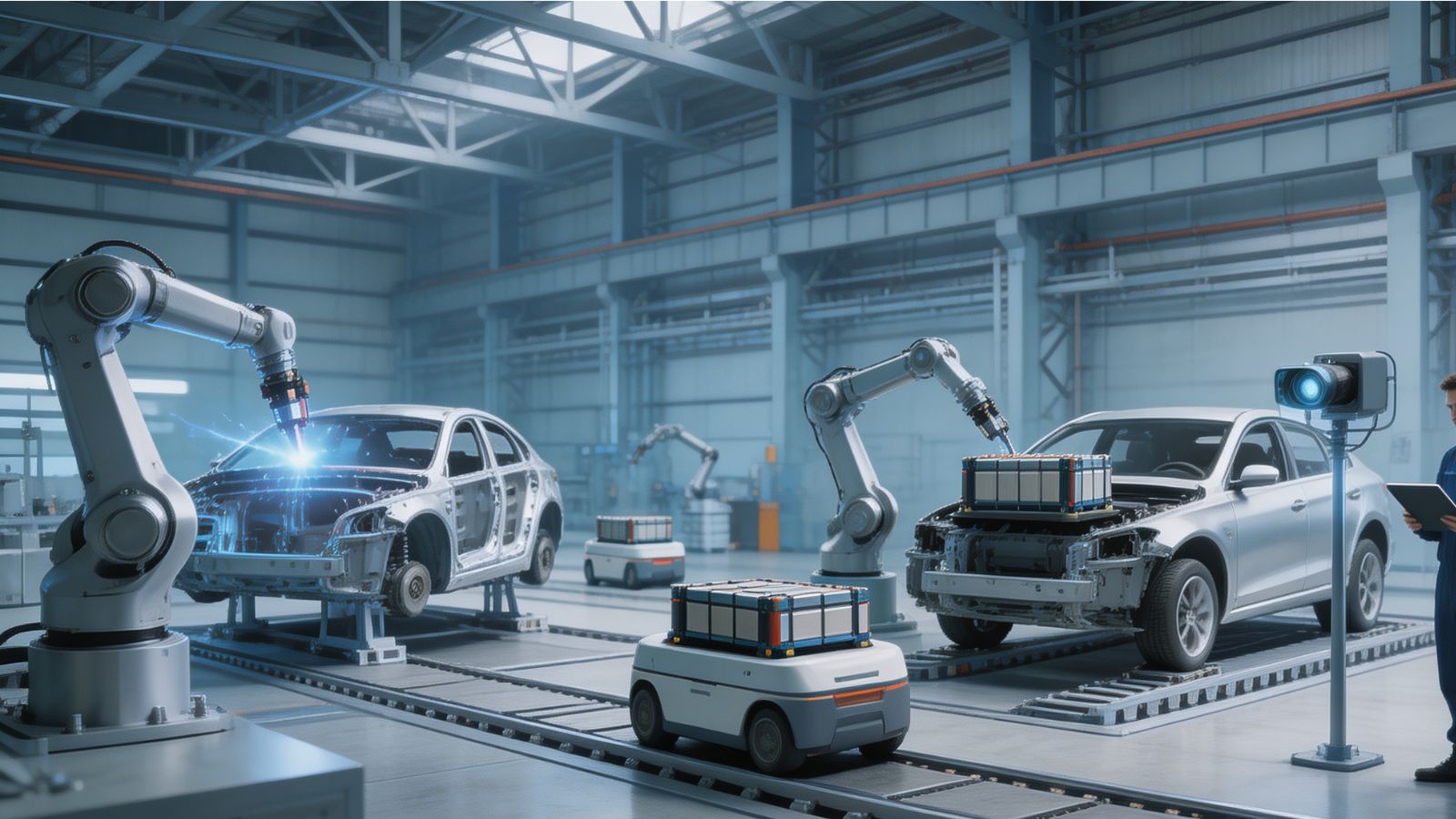
Logistics is one of the clearest examples of physical AI transforming an existing business model. Modern warehouses are no longer just storage facilities; they are complex systems where inventory movement, order accuracy, and delivery speed directly affect customer expectations.
Amazon provides one of the largest examples of warehouse robotics adoption. Its fulfillment centers use autonomous robots to move inventory, support employees, and optimize the flow of products through large-scale operations. The company’s Proteus mobile robot was designed to operate more flexibly in environments shared with human workers.
The importance of Amazon’s robotics approach is not only the machines themselves but the change in warehouse design. Earlier Kiva-based systems allowed shelves of products to move directly to employees instead of requiring workers to walk through large storage areas searching for items. This changed the physical layout of warehouses and reduced unnecessary movement.
Newer AI-based systems are addressing more complicated challenges, including package sorting, handling irregular objects, and navigating spaces where human workers and machines operate together.
Boston Dynamics’ Stretch robot demonstrates another direction for logistics automation. Designed for tasks such as unloading boxes from trailers, Stretch targets a difficult problem because loading areas are often inconsistent, with different package sizes and unpredictable arrangements.
The future warehouse is unlikely to remove humans completely. Instead, robots may increasingly handle repetitive transportation tasks while workers focus on problem-solving, quality control, equipment management, and unexpected situations.
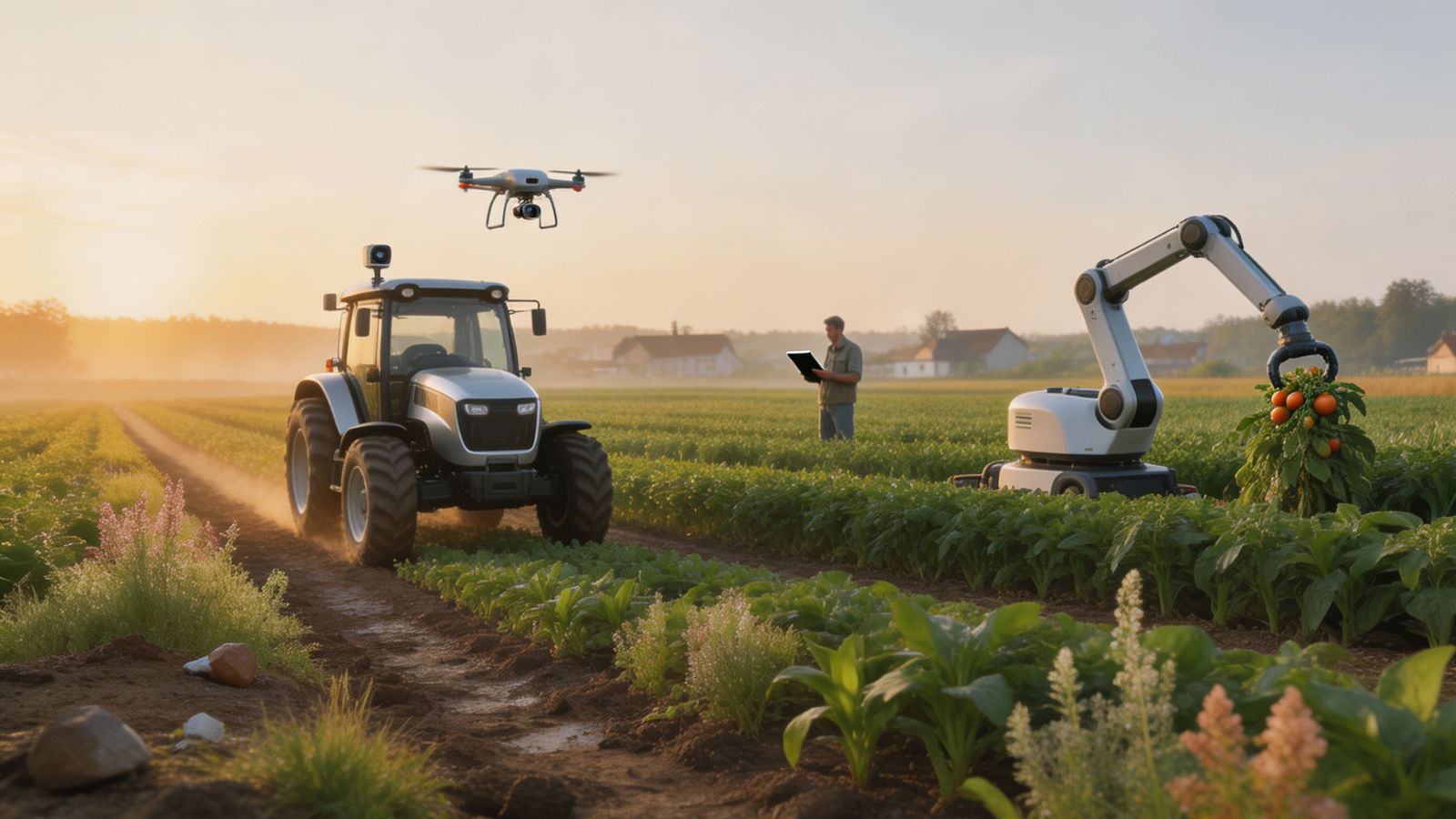
Agriculture shows why physical AI is more complicated than traditional factory automation. Farms operate in environments that cannot be fully controlled, with changing weather, uneven terrain, and biological variation.
Autonomous tractors, crop-monitoring systems, and robotic harvesting technologies are being developed to improve productivity and address labor shortages. John Deere has invested in autonomous farming equipment that uses cameras, sensors, and machine learning to help agricultural machinery operate with reduced human intervention.
The technical challenge is perception. A farming robot must distinguish between crops, weeds, soil, obstacles, and changing environmental conditions. Harvesting delicate products such as strawberries or certain fruits remains particularly difficult because robots must identify maturity, locate individual items, and apply precise force without causing damage.
Commercial adoption also depends on economics. Autonomous farming equipment requires significant investment, and farmers must consider purchase costs, maintenance, software updates, and technical support. Large agricultural operations may adopt these systems sooner because they can spread costs across larger areas, while smaller farms may need lower-cost solutions or service-based models.
Infrastructure is another factor. Reliable connectivity, particularly in rural areas, can affect whether autonomous systems operate effectively.
For agriculture, the first major benefits may come from precision farming tools that improve decisions about irrigation, planting, and resource use rather than replacing agricultural workers entirely.
Healthcare is one of the most promising areas for physical AI, but it also requires some of the highest standards for safety and reliability.
Hospitals are already using robotic systems for specific tasks such as transporting supplies, delivering medications, and supporting internal logistics. These systems can reduce routine workloads and allow medical staff to spend more time on patient care.
Rehabilitation is another area where robotics can provide practical assistance. Robotic devices can help patients perform controlled movements during recovery programs, allowing therapists to deliver more consistent treatment.
Companies developing surgical and rehabilitation robotics have demonstrated that machines can improve precision and repeatability in certain medical procedures. However, these systems are generally designed as tools that extend professional capabilities rather than replace medical judgment.
The biggest barriers in healthcare are not only technical. Privacy protection, cybersecurity, regulatory approval, and patient trust are equally important. A successful healthcare robot must operate safely while fitting into complex human environments.
Construction remains one of the hardest industries to automate because every project has unique designs, materials, and working conditions.
Physical AI may enter construction through specialized applications such as autonomous surveying, robotic inspection, automated equipment, and machines designed for repetitive or hazardous tasks.
Safety is one of the strongest reasons for adoption. Robots could assist with dangerous inspections, heavy material handling, and work in environments where risks to human workers are high.
Unlike manufacturing, construction is unlikely to develop one universal robot capable of completing an entire project. More realistic adoption will involve specialized machines designed for specific tasks.
Transportation represents one of the largest potential impacts of physical AI, but it also faces complex legal and social challenges.
Autonomous vehicles must operate safely around unpredictable human behavior, changing road conditions, and different weather environments. Technical capability alone is not enough. Governments, insurers, manufacturers, and consumers must determine how responsibility is assigned when autonomous systems make decisions.
Commercial applications may expand faster in controlled environments such as ports, warehouses, mining operations, and dedicated freight routes. These settings have fewer variables than public roads and allow companies to measure performance more easily.
Over the next 5–10 years, physical AI is more likely to expand through targeted transportation applications rather than immediate widespread consumer adoption. Progress will depend on safety records, regulatory frameworks, and public acceptance.
The industries transformed first will not necessarily be those with the most advanced robots. They will be industries where automation solves a clear operational problem.
Three factors will shape long-term success:
Industries facing worker shortages or physically demanding tasks have stronger incentives to automate.
Robots perform best when they can reliably understand their surroundings. Controlled factories remain easier to automate than farms, construction sites, and public environments.
The strongest competitive advantage may come from companies that combine robotics with better processes, workforce training, and data-driven decision-making. Buying robots alone does not guarantee better results.
Physical AI and autonomous robotics will create significant economic changes, but those changes will appear unevenly across industries.
Manufacturing and logistics are likely to experience faster transformation because automation already fits their operating models. Agriculture, healthcare, construction, and transportation have substantial opportunities but require solutions to more complex technical and social challenges.
Over the next decade, the most successful companies may not be those that simply deploy the most robots. They will be the organizations that understand where automation creates real value, redesign their workflows, and build effective partnerships between humans and intelligent machines.
The future of physical AI is not only about replacing manual tasks. It is about creating a new model of physical work where technology expands what people and businesses can accomplish.