
Decoding the technologies of tomorrow, today.
Exploring the breakthrough innovations shaping our world. From AI infrastructure and robotics to biotech, quantum computing, and spatial tech.
Exploring the breakthrough innovations shaping our world. From AI infrastructure and robotics to biotech, quantum computing, and spatial tech.
AI assistants began with a relatively simple interaction: a person asked a question, and the system generated a response. That model still works well for writing, brainstorming, summarizing, and many everyday tasks. But increasingly, AI assistants are being designed to do something different: pursue a goal across several steps, use external tools, work with information outside the conversation, and sometimes take actions on a user's behalf.
The shift is not simply about making chatbots smarter. It changes what an AI assistant is expected to do.
A conventional assistant mainly produces information. A more agentic assistant can help carry out a process.
Consider the difference between these two requests:
“Explain the steps for preparing a monthly sales report.”
“Prepare this month's sales report using the files in our shared drive, check the figures against the previous month, and flag anything unusual.”
The first request primarily requires language generation. The second requires a sequence of operations. The assistant needs access to relevant files, determine which information matters, perform comparisons, possibly use analytical tools, and produce a result based on what it finds.
This is one reason the term AI agent has become increasingly common. OpenAI describes agents as systems that can independently accomplish tasks, while Anthropic distinguishes agents from predefined workflows by whether the model dynamically directs its own process and tool use.
The practical difference is autonomy within boundaries. Instead of requiring the user to specify every intermediate step, the system can decide what to do next based on the current state of the task.
That does not mean the assistant is independently thinking like a human. It means the software gives the underlying model a larger role in deciding how a defined objective should be pursued.
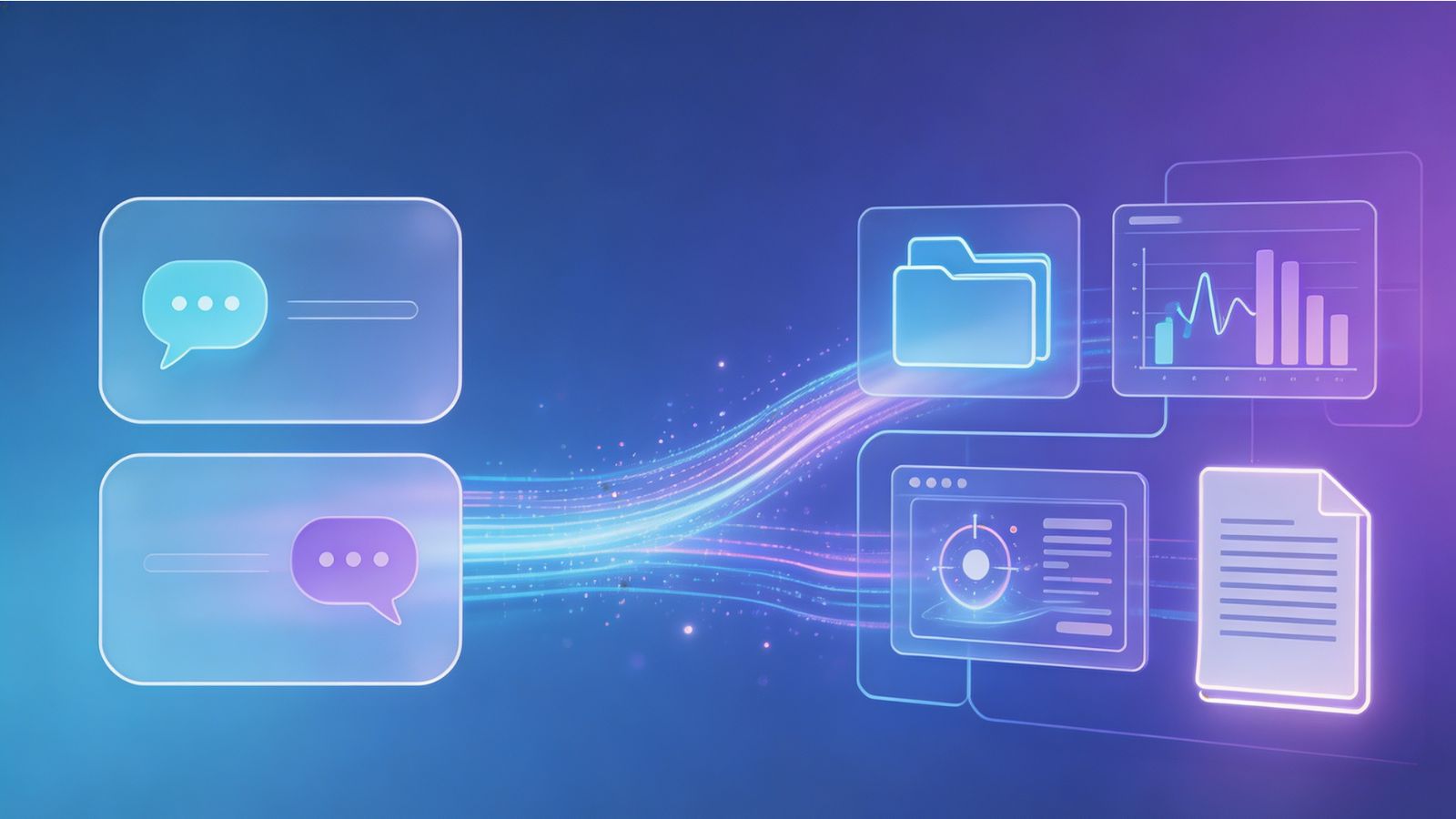
A language model on its own works primarily with the information available in its input and learned parameters. Tool use changes that relationship.
An assistant may be connected to a web search service, a document repository, a calendar, a database, a calculator, or another business application. The model can select an appropriate tool, receive its result, and use that result in the next step.
This creates a basic pattern:
Understand the goal → decide what information or action is needed → use a tool → inspect the result → continue or ask for help.
The significance of this loop is easy to underestimate. A traditional chatbot might tell a user how to check a flight reservation. A tool-enabled assistant could potentially retrieve the reservation itself, provided it has the appropriate access and authorization.
Modern agent systems are therefore less like isolated chat windows and more like an interface between a language model and other software systems. Anthropic's research on agent tools emphasizes that tools need clear boundaries, useful outputs, and interfaces that models can reliably understand.
The tool does not merely add another feature. It gives the assistant a way to obtain information or affect something outside the model.
A second major change is the ability to maintain useful information throughout a task.
For a short question, the conversation itself may provide enough context. Longer assignments are different. An assistant might need to remember what has already been reviewed, which files were relevant, what decisions were made, and which steps remain unfinished.
This is often handled through a combination of conversation context, stored information, retrieval systems, and application-level state.
The distinction matters because “memory” does not necessarily mean the model has permanently learned something. An application can store information externally and provide the relevant material to the model when needed.
The result is an assistant that can maintain continuity without requiring a user to repeat the entire history of a task.
This also explains why modern AI assistants increasingly resemble software systems rather than standalone language models. The model is one component. Context management, permissions, tools, retrieval, state tracking, and evaluation can all determine whether the overall system works reliably.
Simple question-and-answer interfaces generally aim for one useful response. Agentic systems can instead work through intermediate results.
Imagine asking an assistant to research several vendors and recommend one based on price, features, and availability. A capable system might search for information, gather relevant details, discover that one vendor lacks current pricing, look for another source, compare the collected evidence, and then prepare a recommendation.
The important feature is not that every assistant performs this exact process. It is that the system can be designed to adapt its next action based on what happened previously.
Anthropic describes this as a distinction between workflows and agents. A workflow follows predefined paths, while an agent dynamically directs its own process and tool usage. The simpler workflow is often preferable when the task is predictable; greater autonomy becomes useful when the path cannot be known in advance.
That distinction is valuable for businesses because autonomy has a cost. More decision-making can mean greater flexibility, but it can also introduce more opportunities for errors.
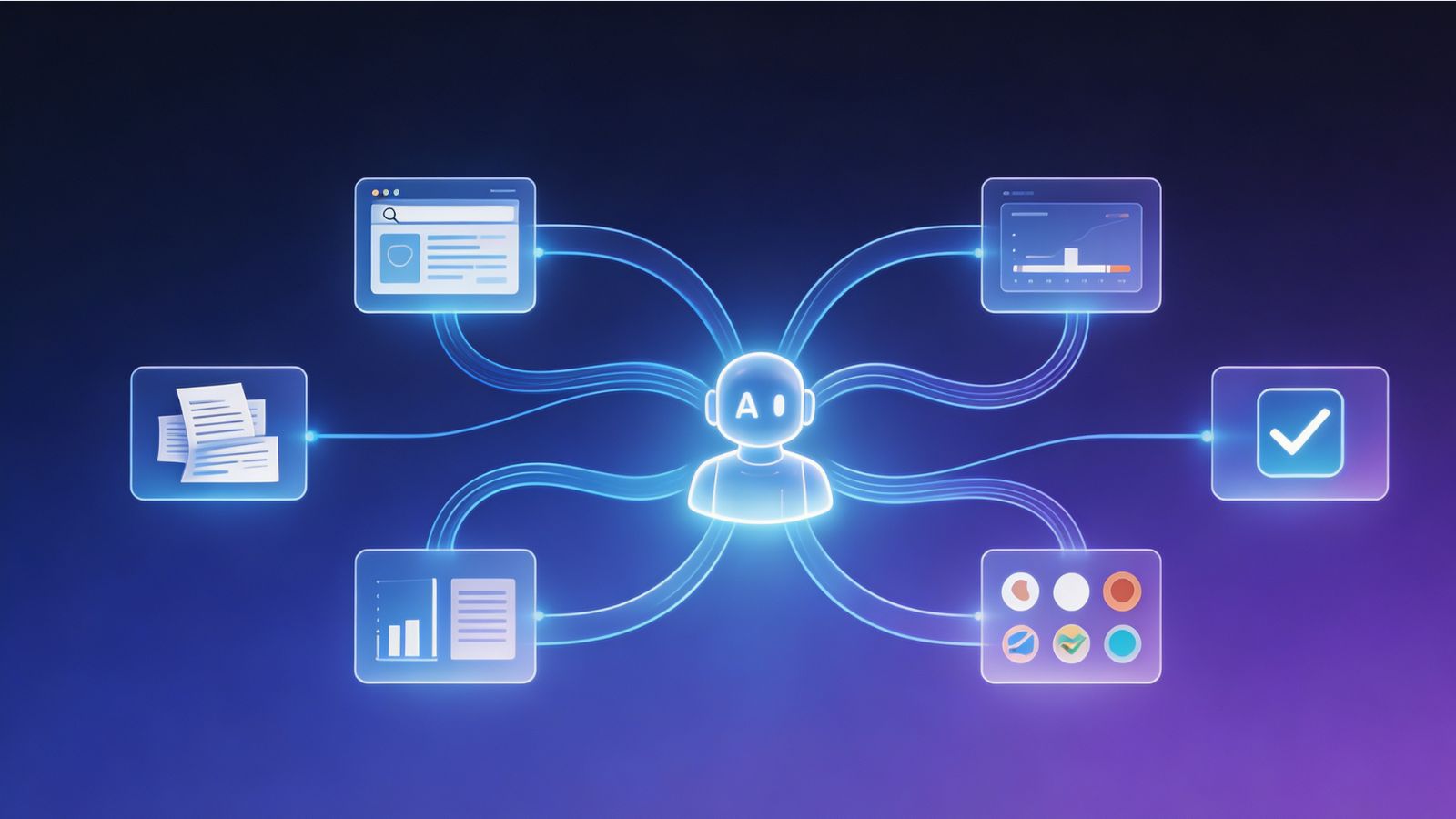
Another important development is where assistants operate.
Instead of existing only as a separate chat page, AI can increasingly appear inside the applications people already use. An assistant might work with company documents, communication systems, calendars, project-management software, or other approved services.
OpenAI's current workspace-agent materials, for example, describe agents around repeatable work involving triggers, processes, skills, and connected tools. Google has also been expanding agentic capabilities across products, describing systems designed not only to answer questions but to help users take actions.
This changes the user's role. Rather than repeatedly translating a business process into individual prompts, a person can define an outcome and allow the system to handle some of the intermediate work.
For repetitive administrative tasks, that can be particularly useful. But it also means the assistant needs appropriate permissions and clearly defined limits.
An assistant that only produces text can still provide an incorrect answer. An assistant that can act through tools has additional ways to fail.
It might misunderstand the user's objective, select the wrong tool, use incomplete information, interpret a tool result incorrectly, or continue down an unproductive path. A system with access to external services can also create consequences that a conventional chatbot cannot.
Security is another concern. Agentic systems can be exposed to prompt injection, in which untrusted content attempts to influence the model into taking actions that conflict with the user's actual intent. Anthropic identifies prompt injection and unintended actions among the risks that become more significant as agents receive greater autonomy.
For that reason, a good agent should not simply be given broad access and left to operate without controls.
Permissions, confirmation requirements, tool restrictions, monitoring, and human intervention can all be part of the design. NIST's AI Risk Management Framework likewise emphasizes managing AI risks according to the system's context, intended use, and risk tolerance rather than treating AI evaluation as a one-time exercise.
There is a temptation to assume that every AI application should become an autonomous agent. The engineering experience so far suggests otherwise.
For a task with a clear sequence, a conventional workflow may be easier to test and more predictable. If a user simply needs a summary, adding multiple tools and decision loops may make the system slower and more expensive without improving the result.
Agents become more attractive when the task is open-ended enough that developers cannot reasonably anticipate every path in advance.
Anthropic explicitly recommends starting with the simplest solution and adding agentic complexity only when it creates meaningful value.
That principle is easy to overlook. An AI assistant does not become better merely because it can perform more actions. The useful question is whether those actions help it complete the user's actual objective more effectively.
The evolution beyond question-and-answer interfaces is best understood as a change in the unit of work.
The old model was largely: ask → answer.
The emerging model is closer to: goal → plan or workflow → tools and information → intermediate results → completed task.
That does not eliminate the need for human judgment. In many situations, it makes judgment more important because users must decide what an assistant is authorized to do, which results require verification, and where human approval should remain in the process.
For developers, the practical lesson is to design around the task rather than the novelty of the technology. Start with a clearly defined outcome, give the assistant only the tools and permissions it needs, keep predictable processes deterministic where possible, and evaluate the complete workflow rather than judging the language model alone.
AI assistants are therefore moving beyond the chat box, but the most meaningful change is not that they can “do more.” It is that they are increasingly becoming participants in software workflows—systems that can gather information, make intermediate decisions, and carry work forward. The challenge now is making that added autonomy useful without allowing it to become unpredictable.