
Decoding the technologies of tomorrow, today.
Exploring the breakthrough innovations shaping our world. From AI infrastructure and robotics to biotech, quantum computing, and spatial tech.
Exploring the breakthrough innovations shaping our world. From AI infrastructure and robotics to biotech, quantum computing, and spatial tech.
Reducing greenhouse gas emissions remains the central strategy for addressing climate change, but many researchers and policymakers recognize that carbon removal technologies may also play a role in managing atmospheric carbon dioxide levels. Direct Air Capture (DAC) is one such approach, designed to extract carbon dioxide (CO₂) directly from ambient air and store it permanently or use it in industrial applications.
Unlike point-source carbon capture systems that remove CO₂ from concentrated emissions streams such as power plants or industrial facilities, DAC operates on ordinary air. This creates a fundamental engineering challenge: carbon dioxide exists in the atmosphere at relatively low concentrations, requiring large volumes of air to be processed.
The technology has attracted significant attention because it could theoretically remove historical emissions and address sectors where eliminating all emissions is difficult. However, commercial deployment faces major obstacles, including thermodynamic limitations, high energy requirements, sorbent durability, infrastructure needs, and the challenge of scaling from small facilities to global climate-relevant capacity.
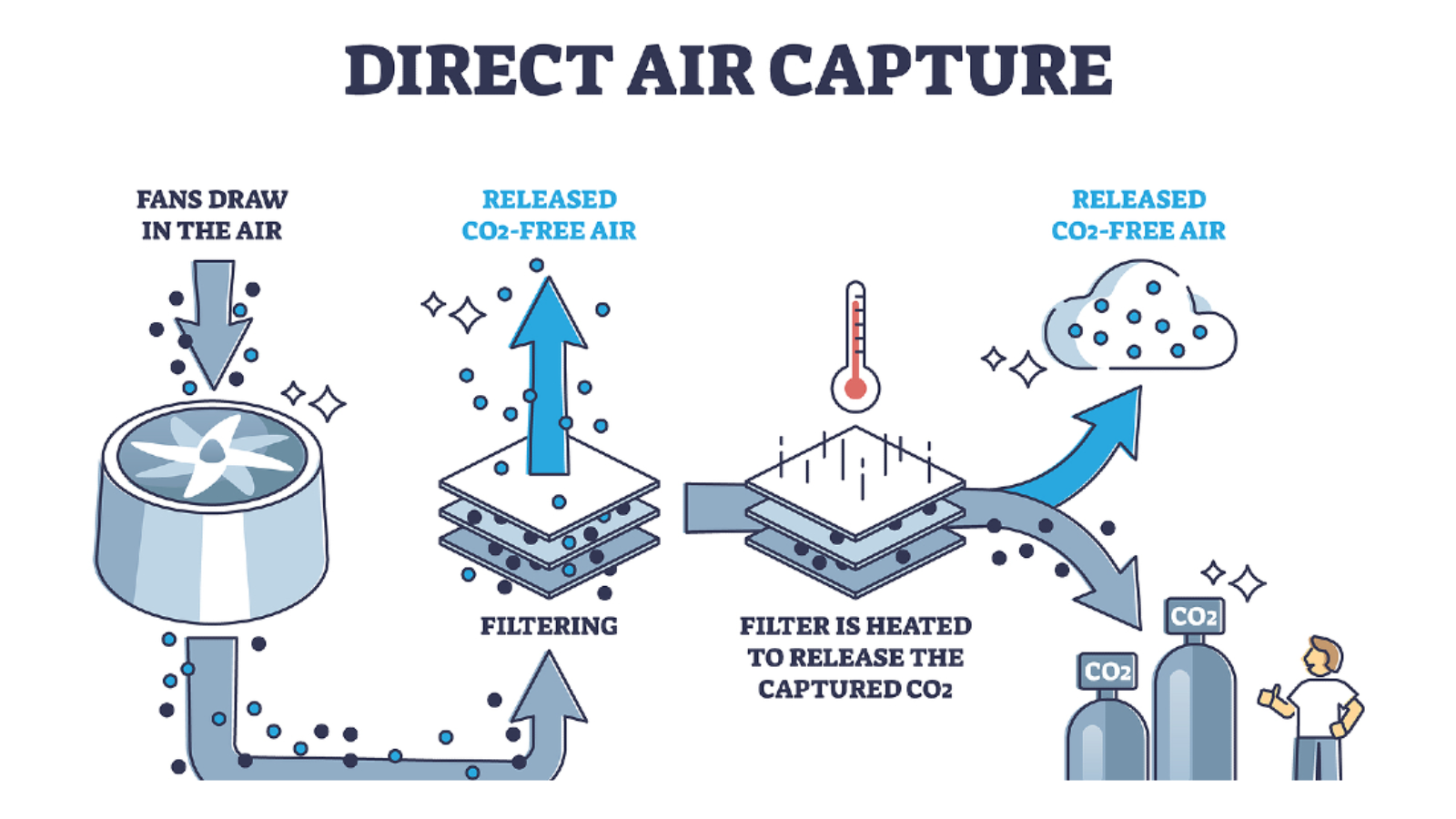
A DAC facility typically uses a combination of air-contacting equipment, chemical materials that capture CO₂, regeneration systems, and storage infrastructure.
The process generally involves four stages:
Air intake: Large fans move atmospheric air through a capture unit.
CO₂ separation: Specialized materials selectively bind carbon dioxide molecules.
Sorbent regeneration: Heat, vacuum, moisture, or chemical processes release concentrated CO₂ from the capture material.
Storage or utilization: The captured CO₂ is transported for permanent storage or converted into products.
Two major DAC approaches dominate current research:
Solid sorbent systems
Liquid solvent systems
Each approach has different engineering advantages and challenges.
One of the biggest challenges in DAC is the low concentration of carbon dioxide in the atmosphere. Current atmospheric CO₂ concentrations are roughly several hundred parts per million, meaning carbon dioxide represents only a small fraction of the air being processed.
From a thermodynamic perspective, separating a dilute substance from a mixture requires energy. The more dispersed the target molecule is, the greater the challenge.
For DAC, energy is required for:
Moving large amounts of air through contactors
Breaking chemical bonds between CO₂ and capture materials
Heating or pressurizing systems during regeneration
Compressing CO₂ for transportation and storage
The minimum theoretical energy required for separation is determined by thermodynamic principles, but practical systems require significantly more energy because of inefficiencies in real equipment.
Engineering improvements aim to reduce these losses through better materials, improved airflow designs, and more efficient regeneration methods.
The effectiveness of a DAC system depends heavily on the material used to capture carbon dioxide.
A good sorbent must balance several properties:
High CO₂ capture capacity
Fast reaction rates
Selectivity toward carbon dioxide
Resistance to degradation
Low regeneration energy requirements
Long operational lifetime
No single sorbent material currently provides an ideal combination of all these characteristics.
Solid sorbents are porous materials that chemically or physically bind CO₂ molecules.
Common research materials include:
Amine-functionalized materials
Metal-organic frameworks
Porous polymers
Solid sorbents can operate at relatively low temperatures and may reduce energy requirements compared with some liquid systems.
However, they face challenges related to:
Moisture sensitivity
Material degradation
Manufacturing costs
Maintaining performance over thousands of cycles
Because DAC facilities must operate continuously for years, sorbent durability is one of the most important commercial considerations.
Liquid solvent systems use chemical solutions that react with carbon dioxide.
These systems are related to technologies already used for capturing CO₂ from industrial emissions.
Advantages include:
Established chemical processes
High capture capacity
Industrial operating experience
However, liquid systems often require significant heat for regeneration, particularly when stronger chemical bonds form between CO₂ and the solvent.
Reducing regeneration energy remains a major research priority.
After a sorbent captures carbon dioxide, the CO₂ must be removed so the material can be reused.
This step is called regeneration.
Different DAC systems use different regeneration methods:
Heat is applied to release captured CO₂.
This approach can be effective but requires a reliable low-carbon heat source. If fossil fuels provide the energy, the emissions associated with operating the DAC system may reduce its climate benefit.
Some systems lower pressure to encourage CO₂ release.
Vacuum methods can reduce temperature requirements but require energy to operate pumps and maintain pressure differences.
Researchers are exploring electrochemical methods and other approaches that may reduce energy consumption.
The ideal DAC system would use renewable electricity and low-carbon heat while maintaining high capture efficiency.
Current DAC facilities are small compared with the scale required for meaningful atmospheric impact.
Global carbon emissions are measured in billions of tons per year, while existing DAC capacity remains relatively limited.
Scaling DAC requires solving several interconnected problems:
Large-scale deployment would require producing enormous quantities of capture materials, fans, reactors, and supporting equipment.
Removing significant amounts of atmospheric CO₂ would require substantial amounts of clean energy.
A future DAC industry must avoid creating additional emissions through energy consumption.
Captured CO₂ requires transportation and storage networks.
Permanent geological storage, where CO₂ is injected into deep underground formations, requires suitable locations, monitoring systems, and regulatory frameworks.
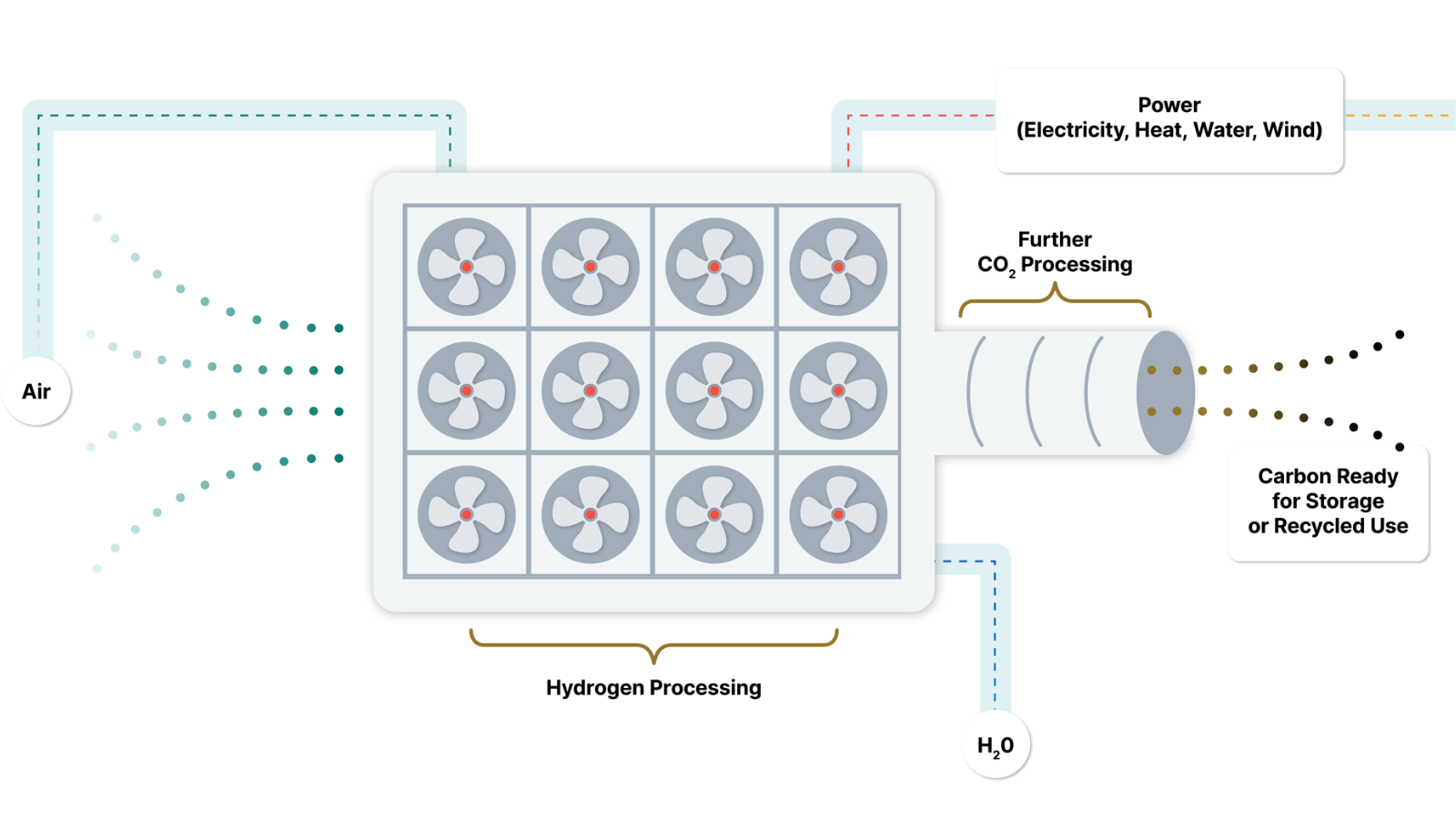
Capturing carbon dioxide is only part of the process. Climate benefits depend on what happens afterward.
Potential pathways include:
Geological storage
Mineralization
Synthetic fuel production
Industrial materials
Permanent storage is generally considered necessary for carbon removal because using CO₂ in products may eventually release it back into the atmosphere.
For example, fuels made from captured CO₂ can reduce dependence on fossil carbon but do not necessarily provide permanent removal if the carbon is later released during combustion.
The cost of DAC remains one of its largest obstacles.
Expenses come from:
Capture equipment
Energy consumption
Sorbent replacement
CO₂ transportation
Storage infrastructure
Reducing costs will require improvements across the entire system rather than a single technological breakthrough.
Potential cost reductions may come from:
More efficient sorbents
Larger manufacturing volumes
Improved process designs
Cheaper renewable energy
Better integration with industrial facilities
Direct Air Capture is unlikely to replace emissions reductions. Reducing fossil fuel consumption, improving energy efficiency, and expanding clean energy remain the primary approaches for limiting future emissions.
Instead, DAC may serve a complementary role by addressing emissions that are difficult to eliminate, such as certain industrial processes or historical emissions already released into the atmosphere.
Its future importance will depend on whether engineers can create systems that are energy-efficient, affordable, and scalable.
Direct Air Capture represents one of the most ambitious approaches to carbon removal, but its development requires overcoming significant scientific and engineering challenges. The low concentration of atmospheric CO₂ creates unavoidable thermodynamic limits, while sorbent regeneration remains a major driver of energy demand.
Scaling DAC from demonstration projects to climate-relevant capacity will require advances in materials science, renewable energy availability, manufacturing, and carbon storage infrastructure.
The technology’s ultimate success will depend not only on capturing carbon dioxide efficiently but also on building complete systems capable of removing carbon at meaningful global scale while maintaining a strong climate benefit.